The Modern Marketer Needs a Data-First DAM Solution
Credits: Published by our strategic partner Tenovos.
In an era of increasing personalization, the key to successful marketing campaigns is effective storytelling that reaches the right audience with the right message at the right moment. If this chemistry between audience, content, and timing is the key to success, creative and marketing professionals have to rely on next-generation asset management technology that can guide them toward the right combinations by replacing guesswork with data, and surrounding content with context.
Traditionally, Digital Asset Management platforms (DAMs) have focused on assisting teams to manage their digital assets and move them from inside the organization to external partners and platforms. The premise is simple: a central repository where brands can store their assets alongside relevant metadata to make everything easy to find — photos and videos, logos and tear sheets, and any other brand collateral that needs to be used and reused.
At its most basic level, a good DAM solution enables marketers to do their jobs more efficiently. More modern DAMs employ AI and machine learning to automatically add relevant tags to assets, so teams can spend less time on tedious tasks like tagging or finding assets and more time on the creative and analytical areas of their jobs. The most advanced DAM platforms, however, go beyond managing and moving assets, to actually measuring their performance in their context of use.
Building a DAM for the Modern Enterprise
Over the past 20 years, the pace of change in technology has exploded, while the DAM category has lagged behind in innovation. Brands have come to expect an exceptional, personalized user experience complete with smart insights from their marketing platforms, and DAM should be no exception. As marketing becomes increasingly fast-paced and data-driven, it’s time for a completely new and different DAM experience — one that can meet the demands of an increasingly tech-savvy industry and understands its pain points.
The first and most important question that a DAM provider should ask is, ‘how does my solution help marketers do their jobs more effectively?’ That is, after all, the central goal of a DAM system: to make it easier and more efficient for creators and marketers to collaborate to design and execute successful campaigns. In other words, if finding an asset within the DAM system and searching through emails to find it take approximately the same amount of time, the system is not making teams more efficient — it’s simply adding a layer of complexity to their martech stack.
Creating a Seamless User Experience
Not all DAM platforms are created equal. One common issue that many enterprises face is the inability to seamlessly integrate their DAM platform with the rest of their marketing ecosystem, which can essentially negate the efficiencies gained by using an asset management solution in the first place. Considering that the code base of many solutions currently on the market is over a decade old (older, in some cases), this is a problem that will only get worse over time as marketers look to incorporate new tools and technologies into their workflows. Consequently, it’s important to find and implement a solution that leverages the use of modern technologies — such as AI/ML, micro-services, graph databases, and serverless environments — that will be able to maintain its speed and flexibility in the years to come.
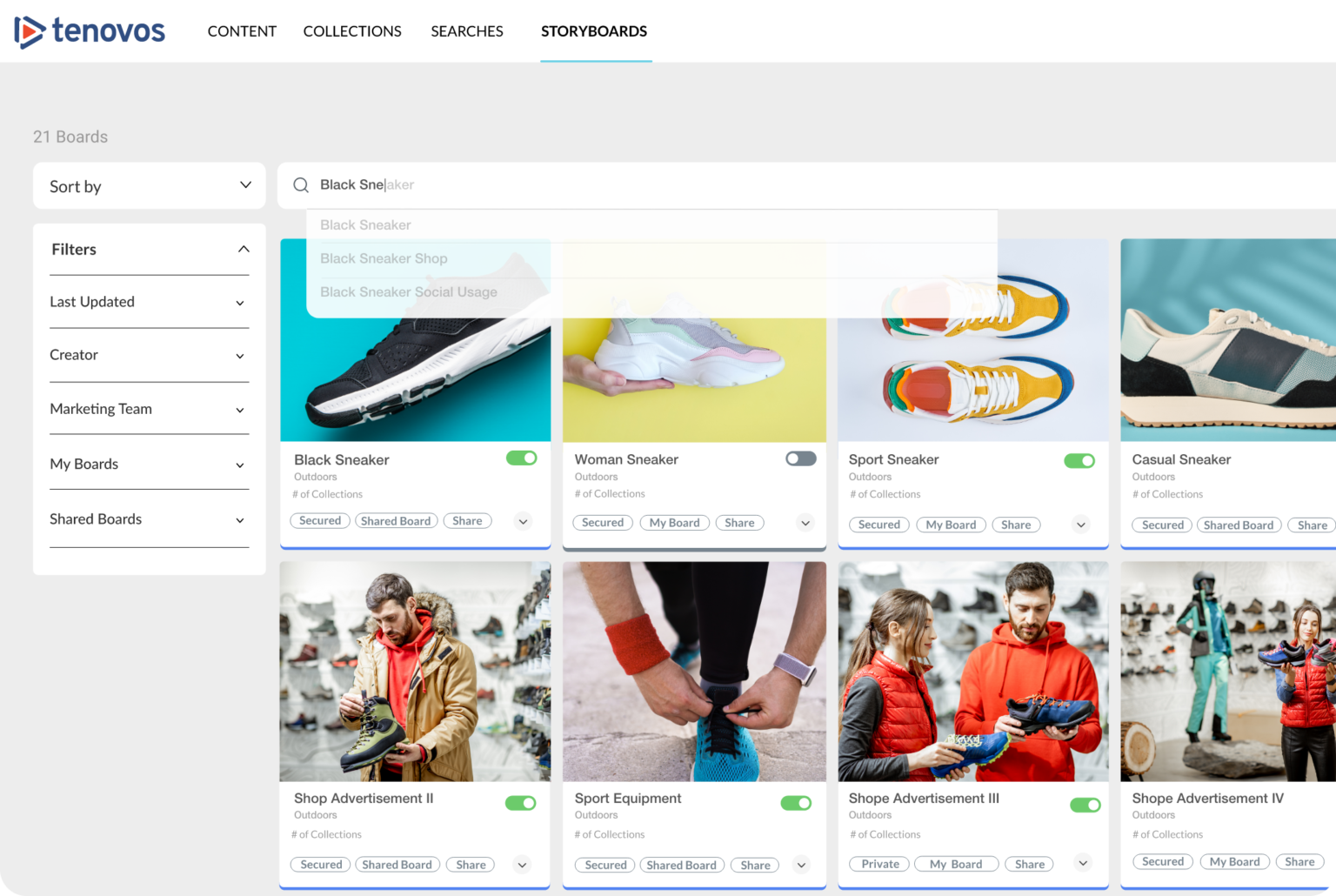
An organization’s ability to collaborate seamlessly with team members across — and outside of — the organization is also a key indicator of the success of a DAM implementation. Marketing doesn’t happen in a single silo; from research to ideation, to creation to deployment, marketing is interconnected and interdisciplinary. A modern DAM platform should connect the enterprise in such a way that it simplifies the creative life cycle and enables marketers to reduce the friction and time required to launch each new campaign.
Data-Driven Marketers Need Data-Driven Technology
The reality is that many of the DAM solutions available on the market currently have not kept pace with the evolving needs of the increasingly data-driven marketing operation; they’re often expensive, difficult to implement, and don’t deliver the user experience marketers and creative professionals have come to expect from their technology. Seen from this angle, it’s not surprising that many organizations are hesitant to invest heavily in a new system that is not capable of demonstrating a return on investment.
Brands need modern DAM platforms that not only enable them to meet the demands of marketing in the digital age, but also help them to demonstrate — and improve — their ROI. Marketers should expect their DAM platform to provide:
- A data-first approach to asset management that allows brands to measure and optimize their processes and their content to provide increasingly personalized experiences
- A seamless user experience that drives adoption and enables teams across the world to collaborate easily
- Performance and optimization capabilities underpinned by artificial intelligence and machine learning
- Continuous improvement and delivery to support the demands of a global omnichannel enterprise
At the end of the day, companies implement a DAM solution in order to optimize their processes and improve their ability to tell the compelling stories that are central to a successful marketing operation. This optimization should come not only in the form of improving the speed of creation, but also the strategy behind a given campaign. A system that has access to all of the contextual data that surrounds your every asset should be able to distill those data into insights that inform the creation of future content.
A modern, data-first DAM should act not only as a content database but also as a source of insight to enable marketers to make smarter creative decisions, which in turn allows them to tell stories that matter to their audience.
Want to know what types of data your DAM should be providing? Reach us at marketing@sifycorp.com
Written by Michael Waldron, CMO, Tenovos


eLearning Solutions to Mitigate Unconscious Hiring Bias
The Hiring Bias
In study after study, the hiring process has been proven biased and unfair, with sexism, racism, ageism, and other inherently extraneous factors playing a malevolent role. Instead of skills or experience-based recruiting, it is often the case that interviewees get the nod for reasons that have little to do with the attributes they bring to an employer.
“This causes us to make decisions in favor of one person or group to the detriment of others,” says Francesca Gino, Harvard School of Business professor describing the consequences in the workplace. “This can stymie diversity, recruiting, promotion, and retention efforts.”
Companies that adhere to principles of impartial and non-biased behavior and that want to increase workforce diversity are already hard-pressed to hire the best talent in the nation’s current environment of full-employment and staff scarcity.
Five Main Grounds for Hiring Bias
Researchers have identified a dozen or so hiring biases, starting with a recruiting ad’s phrasing that emphasizes attributes such as “competitive” and “determined” that are associated with the male gender. In fact, study findings have reiterated that even seasoned HR recruiters often fall prey to faulty associations.
Here are five of the most frequently cited reasons for the unintended bias in the hiring process:
- Confirmation Bias: Instead of proceeding with all the traditional aspects of an interview, interviewers often make up their minds in the first few minutes of talking with a candidate. The rest of the interview is then conducted in a manner to simply confirm their initial impressions.
- Expectation Anchor: In this case, interviewers get fixated on one attribute that the interviewee possess at the expense of what backgrounds and skills other applicants can bring to the interview process.
- Availability Heuristic: Although this may sound somewhat technical, all it means is that the interviewer’s judgmental attitude takes over. Examples might be the applicant’s height or weight, or something as mundane as his or her name, reminding the interviewer of someone else.
- Intuition-Based Bias: This applies to interviewers who pass judgment based on their “gut feeling” or “sixth sense”. Instead of evaluating the candidate’s achievements, this depends solely on the interviewer’s frame of mind and his or her own prejudices.
- Confirmation Bias: When the interviewer has preconceptions on significant aspects of what an applicant ought to offer, everything else gets blotted out. This often occurs when, within the first few minutes of talking with an applicant, the interviewer decides in his or her favor at the expense of everything else that other candidates may have to offer.
Why Bias Is a Problem
In a book titled The Difference: How the Power of Diversity Creates Better groups, Firms, Schools and Societies, Scot E. Page, professor of Complex Systems, Political Science and Economies at the University of Michigan, employs scientific models and corporate backgrounds to demonstrate how diversity in staffing leads to organizational advantages.
Despite the mountain of evidence, the fact remains that many fast-growing companies are still not deliberate enough in their recruiting practices, often times ending up allowing unconscious biases to permeate in their methods.
Diversity in hiring, an oft-used term, is essentially a reflection on different ways of thinking rather than on other biases. For example, a group of think-alike employees might have gotten stuck on a problem that a more diverse team might have tackled successfully using diverse thinking angles.

Automated Solutions
Although hiring bias is normally shunned, this in no way implies that it doesn’t proliferate amidst large and small organizations alike. The tech industry—and Silicon Valley in particular—was shaken recently by accusations of bias in the workplace, driving many HR managers and C-Suite executives to look for “blind” hiring solutions.
To pave the way for a more diverse workforce—one that is built purely on merit—there is recruiting software built to systematize vetting and maintain each candidate’s anonymity. These packages enable companies to select candidates through a blind process. Instead of looking at an applicant’s resumé through the usual prism of schools, diplomas and past company employers, the first wave of screening can be done based purely on abilities and achievements.
Other packages also enable the employer to write blind recruiting ads, depicting job descriptions that do away with key phrases and words that are associated with a particular demographic—masculine-implied words such as “driven”, “adventurous”, or “independent”, and those that are feminine-coded such as “honest”, “loyal”, and “interpersonal”.
eLearning Case Studies
Companies are now attempting to make diversity and inclusion—from entry-level employees to the executive suite—hallmarks of their corporate culture. With an objective to identify and address unconscious bias in all processes and behaviors, companies can introduce unconscious bias training curriculum for first-line managers, by calling on eLearning companies for their eLearning courseware and content.

Confronting Hiring Bias in a Virtual Reality Environment
Virtual Reality (VR) technology can further boost unintended hiring bias. In a simulated setting, the user manipulates an avatar that was able to assume any number of demographics for applicants in the hiring process. Based on the gender or ethnicity of the avatar, the user experiences bias during question and answer sessions. The solution would use an immersive VR environment, a diverse collection of avatars, and sample scenarios to pinpoint to participants where bias is demonstrated and understood.

Transform High-tech Curriculum with Sify eLearning Experts
For high-tech curriculums, Training Directors (TD) need to address Millennial and Gen-Z (MGZ) workforce’s
need for self-paced content in addition to the traditional instructor-led, in-person courses. “Meeting the learner”
has become a term reflecting a corporate necessity. In a perfect world, SME’s could easily transform their
knowledge and the classroom instruction to engaging, effective self-paced content. Often, organizations do not
have the bandwidth to keep instructors out of the classrooms for long periods to support content creation.
Download whitepaper

AR based training support
Overview
This article describes the Augmented Reality (AR)-based training/performance support tool implemented at a Pharma Manufacturing Division with an objective to cut down training time but simultaneously accelerate the time to competency in Operators to achieve desired business outcomes. The AR tool is designed to help new hires and less experienced Operators working in high-speed pharmaceutical packaging line to quickly upskill on the standard operating procedure (SOP) of the
splicing process of the GUK machine.
Download whitepaper