Consolidate your Network with Sify
Rationalize, Scale, and Manage your network effortlessly.
In todayβs technologically advanced era, enterprises across realms have complex ICT environments β virtual and geographically spread. The advent of Cloud and rise of multiple solution providers globally have encouraged organizations to pick and choose the perfect mix to host their applications, servers, and data across a diverse landscape of Data Centers and multiple clouds. This has benefitted organizations worldwide, in terms of ease of operations, higher level of flexibility and better speed to market. However, at the same time, one must acknowledge that management of such a highly complex ICT environment has become a major challenge for many organizations in the digital era.
Organizations must understand that all the components of their diverse IT and network infrastructure β consisting of applications, servers, machines, network peripheral equipment, sensors, or even distinct Cloud environments β are not discrete or isolated units anymore, but a part of a larger organization context, making them extremely valuable for business progression and business continuity. All these components must be unified and viewed in a consolidated way for better performance and security.Β Thatβs where, Network Consolidation becomes imperative!
Organizations that have complex ICT environments face distinct challenges that hamper their overall performance and efficiency. Some of the most common challenges in this changing and ever evolving Network and IT environment are:
- Multiple service providers management: Modern enterprises leverage a perfect blend of best-of-breed network solutions from distinct service providers as this ensures advantages of redundancy, resiliency, choice of network media, and connectivity to remote locations. However, managing all the distinct service providers is quite a challenging task and has some inherent problems, such as lack of ownership and visibility, inconsistency in services, inability to leverage analytics, and governance related risks.
- Limited in-house network management capabilities: This is another major concern for organizations across industry verticals. If they opt for establishing an in-house network management setup, then it becomes a very cost-intensive decision to hire the skilled workforce, procure the technology, develop the competence, and achieve a high level of scalability. Furthermore, an in-house setup would need hefty and timely investments to keep pace with evolving technology landscape.
- The demand for constantly re-architecting network: Every enterprise network nowadays has a host of different applications, which has given rise to changed traffic patterns. These mission-critical applications demand uninterrupted collaboration and traffic exchange, which calls for a continuous re-architecting of network to connect data, applications, people, and varied components of the IT infrastructure.
- Shift of focus from Network uptime to Application performance: Traditionally, network has always been uptime-focused, however in current situation where applications are hosted in multiple of Data Centers, Public & Pvt Clouds, businesses are more concerned about how applications perform over the network as this directly impacts the end user experience. The changing demands of high-performance computing and fast cloud migrations have led to a change in paradigm for networks with their SLAs being evaluated on Application intent rather than Network intent. Therefore, new-age networks must capably meet the rising needs of all mission-critical applications that are running concurrently.
- Unification of underlay and overlay networks: To meet changing demands of businesses, networks have grown and evolved organically over different periods of time. This has resulted in complex architectures of underlay & overlay networks. With changing priorities of organizations and rise of application-focused networks, it is important to unify the underlay and overlay networks for optimal utilization, enhanced efficiency, improved user experience, and robust security.
- Connectivity across DC and Cloud landscape: With increased Cloud adoption, it is very important to maintain a perfect sync between data centers and Cloud. Therefore, they need an excellent Network Interconnection that can guarantee seamless connectivity across all the data centers, Cloud environments, international cable landing stations, third party telco infrastructure, etc. for deterministic connectivity and extensive reach.
- Integration of IT, OT, and People: Majority of organizations nowadays have geographically distributed offices, where employees and end users use multiple devices in different regions. It is important to allow them secure and fast access to applications in Cloud and data centers for better experience, collaboration, and organizational efficiency. At the same time, the same Network must ensure seamless connectivity of IT Infrastructure as well as OT assets like WiFi access points, IoT devices and sensors. Herein, network plays an important role in integration of all aspects of IT, OT, and people.
As discussed above, organizations with complex ICT environments face distinct challenges. This not only hampers efficiency and performance but also impacts end user experience, hence compelling organizations to revisit their network strategies. Enterprises want actionable information to be available to end users wherever they are. The rise in mobility and multitude of devices has paved way for direct access to corporate information, which highlights the need of secure and consolidated network which can be scaled rapidly on-demand. The CIOs need to have complete visibility of all network assets and take decisions on network performance and network behavior dynamically. This can be achieved only through network consolidation.
Consolidating your network under one trusted service provider will ensure you a centralized real-time visibility and control over your entire network. Network consolidation improves network performance management and makes network provisioning easier with lesser handoff points between providers, devices, and IT assets, at a reduced cost!
Network consolidation becomes a very complex task and it has a lot of parameters and moving parts to be looked into. Therefore, it is imperative to seek an expert guidance in this quest.
Sify can help you accomplish your Network Consolidation goals. Some of the key differentiators that make us the preferred network consolidation partner are:
- Hybrid Network Strategy β Use of Internet for Business Applications:Β The shift from data centers towards Cloud has resulted in more prevalent use of the Internet as a connectivity option, in addition to MPLS. Today, an SLA-defined Internet strategy is a more reliable and pervasive way to establish a robust connectivity throughout the widely spread ICT environment. Hence, modern day businesses need hybrid WAN strategy β use of internet for business applications along with MPLS. Sify is empowered with Indiaβs largest MPLS Network covering 1,600 towns and cities across India with 3,100 Points of Presence. We provide consistent, secure, high-speed Internet connectivity in more than 130 countries together with 800+ local and global partners. With our robust MPLS and Internet services, we can help you consolidate your network for both primary and secondary connectivity needs.
- Cloud Ready Networks β Advantage Hyper-scale:Β As majority of modern enterprises opt for hybrid or multi-cloud model, enterprises need ubiquitous connectivity to data centers and public Clouds. Sifyβs robust interconnection network helps enterprises connect and integrate with Hyper-scalers seamlessly to simplify Cloud connectivity and reduce provisioning time. Our interconnection network improves cross-cloud application interaction, performance, and scalability, which ultimately paves way for enhanced quality of experience. Sify enjoys a great stature in the India Cloud market as we are the preferred partner of all major Hyper-scalers such as AWS, Azure, Oracle, and GCP including their respective Cloud connect services. With our Cloud connect, DC Interconnects and carrier neutral network with multiple internet exchanges, we deliver a well-architected and cost-effective Cloud-ready network for a secure, low latency and deterministic connectivity.
- Strategic Move from Wireless to Wireline Connectivity Media β More relevant than ever:Β Today, convergence of wireless and wireline is happening at a lightening pace. Till now, fiber penetration was restricted to backbone networks in the network value chain; however, as we move to the hyper-connected era, networks fiberization becomes important for the increasing cloud adoption. Therefore, Sify has invested in dense fiberization in backhaul and last mile connectivity. Sifyβs state of the art 100G ethernet infrastructure β Metro-XConnect integrates multiple Clouds, our Cloud-adjacent data centers, third party data centers, and transit points in the Network. Our investments into Metro-XConnect can help customers consolidate their networks and leverage multiple benefits of Cloud, such as low latency, high reliability, improved scalability, and uninterrupted operations.
- Strong Managed Services and Network Operations Outsourcing capabilities:Β Empowered with strong Managed Services and Network Operations Outsourcing capabilities, Sify can help you integrate, consolidate, and transform your networks across varied ICT environments for visibility, control, and easy orchestration. Our integrated skillsets, processes, toolsets as well as the state-of-the-art Network Operations Center (NOC) and Security Operations Centre (SOC) can enable you to monitor and manage network and security devices comprehensively. Our NOC services are SLA-driven and outcome-based, which ensures predictable performance. Sify also helps in assessing & consolidating WAN networks; redesigning & reengineering as-is WAN network; and managing Network and Network assets 24X7. Additionally, you can outsource your Network operations and management, including management of all service providers and vendors.
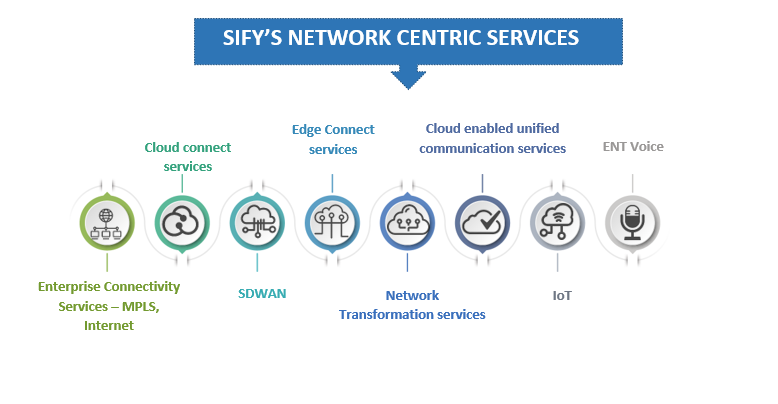
- Integrated capabilities across Core, Management Layer, and Edge :Β In the digital age, enterprises need to focus on faster compute and Edge connectivity. To accomplish this goal, it is important to transform and rearchitect your network β at the core, the management & visibility layer, and the Edge. With our DC and Cloud Interconnects, combined with expertise to deploy technologies like SDWAN and NFV, we hold expertise in network transformation at the core. At the Network Management layer, Sify can manage your WAN, provide 24Γ7 monitoring of links, undertake network management under a unified SLA across multiple service providers. At the Edge, Sify ensures end to end implementation and access configuration of Wi-Fi, IoT devices and integration with the Enterprise Network.
Network Security, the key to VoIP adoption
With growing Internet infrastructure and new technologies, VoIP (Voice over Internet Protocol) has gained tremendous popularity among businesses. Regardless of size and industry, organizations are migrating their communication network from traditional PSTNs to VoIP. The wide-ranging benefits of the system are bound to attract businesses from across the board β reliability combined with steep cost savings and a plethora of productivity-enhancing features make it the communication network of choice for enterprises.
But, in todayβs landscape of increasing cyber-attacks, VoIP must also strengthen its security protocols to ensure businesses are not left vulnerable to malicious cyber agents.
Main Security Threats faced by VoIP
VoIP networks are open to the following threats
- Identity and service threatΒ β this usually involves eavesdropping and phreaking β Eavesdropping is a scenario in which attackers infiltrate the VoIP lines to listen in to conversations to gain access to sensitive business data or private information and accounts to carry out corporate sabotage or identity theft. Phreaking is a term used for the practice of passing off call charges to other accounts by getting unauthorized access to their VoIP service.
- Viruses and MalwareΒ β the bane of all Internet-based services β VoIP services are also open to attacks by malware, worms, and viruses.
- Denial of ServiceΒ β Another threat that is used most often against Internet-based services β DOS can bring the communication network to a halt by flooding it with unnecessary messages.
- Call tamperingΒ β call tampering refers to the practice of interrupting the call by injecting noise packets in the network or withholding call packets to cause call delays and poor call quality. Call hijacking is another form of call tampering in which an outside party enters the call and tricks the person on the other line by masquerading as the original caller.
How are VoIP service providers countering these security challenges?
Service Providers understand that the continued popularity of VoIP services depends, to a large degree, on how secure and comfortable businesses feel while using these services. The VoIP providers and organizations have given top priority to securing their communication networks and have spent the considerable amount of effort and money in putting together some of the most cutting-edge security solutions to safeguard their systems.
The threats listed above can be taken care of by a judicious mix of preventive measures β
- SBCs (Session Border Controllers)Β β SBCs manage VoIP protocol signals and with in-built security firewalls they are the first and one of the most effective lines of defense against cyber threats.
- Anti-virusΒ β installing and operating an updated anti-virus or anti-malware on all connected computer hardware is especially important as they can enter the VoIP network through unsecured channels.
- EncryptionΒ β usually provided by the service providers as an add-on service to secure the network and is highly recommended for enterprise users. VoIP encryption is especially important when the organization has many users connecting from outside the office network β from mobiles or from home devices.
- Call restrictions, authorization, and passwordsΒ β businesses must restrict access to the VoIP network by making sure that only the required people are given access to the network. This along with call restrictions, to track and monitor call activity and stringent password policies can ensure that people within the organizations are made aware of the importance of keeping the network secure.
- Deep Packet InspectionΒ (DPI) β DPI monitors the network and can identify extra or fraudulent data packets and flag them for review.
- VoIP authenticationΒ protocolsΒ β the most stringent of these protocols is the so-called three-way handshake β Challenge-Handshake Authentication Protocol (CHAP) uses a three-step process to test the legitimacy of the incoming messages and is far superior to basic password protection which is widely used.
Conclusion
While the future of VoIP services is secure β the benefits of the technology ensures that β security concerns that have dogged all Internet-based services are also giving network engineers sleepless nights. From cloud platforms to on-premise IT infrastructures, all systems have vulnerabilities that can be exploited and as Cyber-attacks become more aggressive and better organized no one is truly safe.
It is estimated that the global cost of cybercrime will reachΒ $2 trillion by 2019Β β keeping these numbers in mind organizations can no longer count on just plain old luck to keep their businesses safe, they need to be prepared for the worst. And this is especially true for mission-critical functions like communication!
Here, VOIP is clearly the solution of choice for organizations looking for a secure communications network.
Traditional vs VoIP- Whatβs best for your business?
As more and more businesses, both big and small, are jumping on the VoIP (Voice over IP) bandwagon, it is interesting to examine what is causing this exodus from the traditional alternative of PSTN (Public Switched Telephone Network) including Mobiles and Landlines.
In order to understand the reasons for the switch, it is important to first appreciate what is significant for these businesses while opting for a communication system. The chief concerns for businesses, irrespective of their size, while choosing a network are,
- How toΒ reduce costsΒ and at the same time not compromise on the quality of the communication system.
- Is there a way that wouldΒ improve communication with customers and employeesΒ and better connect them?
- How toΒ achieve more value for your moneyΒ and get additional features at the same cost.
- Can the communication system contribute to anΒ increase in efficiency and productivity?
As VoIP addresses these concerns and provides a powerful tool for businesses to βup their gameβ, enterprises in increasing numbers are opting for this alternative.
Cost-Effective Choice
A VoIP solution has a definite edge over its PSTN alternative as it offers free CUG (VoIP-to-VoIP) calling for both local and international. The calls made to mobile and landline phones through VoIP have nominal subscription fees as against a much more expensive PSTN alternative. The sound quality is continually improving as the technology is evolving, providing superior communications and better filtering of background noise with VoIP. Its online conferencing and other features help reduce the requirement for travel. It also has a lesser bandwidth requirement (10 Kbps) than the PSTNs (64 Kbps).
Improve Communication with Customers and Employees
VoIP provides unified communication, helping the employees to work remotely from any place with an Internet connection and βtake the officeβ with them. It also provides the βpresenceβ technology that enables users to see if employees are available and accordingly get in touch with them. PSTNs on the other hand, are able to provide the remote extension facility only with dedicated lines for each extension and hence are very expensive.
More Value for Money
VoIP solution provides an ease of scalability without adding significant infrastructure and cost to the decision. Additionally, VoIP offers call waiting, call forwarding and call transfer options as a standard offering, but the same is available in PSTNs at an additional cost.
Increased Efficiency and Productivity
VoIP has an edge over its traditional counterpart as it allows businesses to get enterprise class software at an affordable cost. As the cost of scalability is low, even smaller businesses can enjoy customized solutions with many features as standard or as an affordable add-on. These lead to increased productivity, less down time, and hence more profit. However, as the service terminates when the Internet connectivity (power) is lost, organizations must have a VoIP backup plan. PSTNs, nevertheless, are able to continue service during power outages, as phone jacks do not require electricity.
Hence, traditional choices such as PSTNs are making way for VoIP as the latter are proving themselves as a powerful tool, giving the businesses a competitive edge and providing the βright-sizeβ technology at an affordable price.
As Indiaβs first ICT Company to be listed on NASDAQ, Sify has years of experience in providing reliable and secure Network Integration services to enterprises across industry verticals.
Our cutting-edge networking services ensure reliable data connectivity services as well as the best-in-class Voice services in India β all available as the cost effective payment models aligned to scale with the growing needs of individual businesses.
Transform the corporate workplace with Managed WLAN
When it comes to Internet connectivity in an organization, user expectations are sky high! Employees and guests, alike, expect fast, secure and highly available WLAN services the moment they step into office premises. To match this growing demand, several organizations have opted for subscription basedΒ Managed WLAN services.
Apart from easing business operations and enriching the corporate work culture, Managed WLAN services contribute directly to business productivity and profitability. To better illustrate the scope and benefits of an outsourced cloud based Wi-Fi setup we look at how an ITES enterprise can be transformed by managed WLAN services.
Challenges and Needs
In a large global company with thousands of employees spread across various regional offices in India, WLAN systems are complex projects that require dedicated management and support.
For an enterprise spanning vast geographies, the challenge is to provide secure and reliableΒ Wi-Fi Internet access to users in all the regional officeΒ across the country. The enterprise would also require dependable connectivity at aΒ desired bandwidth to ensure a certain speedΒ for executing business critical functions.
What does a managed WLAN service provider bring to the table?
Managed WLAN services is so much more than providing access and managing corporate users, itβs a 360Β° process that starts right from theΒ designΒ phase β a team of Network experts study the organizational layout and its bandwidth requirements and design a WLAN plan based on their analysis.
The technology partner will then start theΒ engineering and installation process. This includes β
- Installing an Internet link of required bandwidth, based on the number of users expected to access the Internet.
- Deployment of Wireless Access Points at all corporate branches, including cabling and PoE injectors/ switches.
- Configuration of wireless SSIDs.
- Building a customized corporate homepage with access control through user login.
Once the WLAN system is in place, the solution provider takes over theΒ daily management and monitoringΒ of the Wi-Fi ecosystem. This takes the form of β
- A cloud based centralized WLAN monitoring console to observe the network and detect, prevent and mitigate wireless attacks. The client is also able to gain 360Β° network visibility and userβlevel and application-level control.
- A centralized authentication system to provide network access based on users, devices type and location.
- A guest management portal to provide access to guests and temporary users.
How does Managed WLAN transform the corporate workplace?
After implementing a managed WLAN solution, the first and the most perceptible benefit isΒ seamless and smooth connectivity for all users. Employees and guests alike can now bank on reliable wireless connectivity that can be accessed easily.
A managed WLAN service alsoΒ frees up the core IT personnelΒ from the daily operations of network management, giving them time to focus on areas of strategic business importance.
The network managers are also given completeΒ network visibility and control. Along with being able to easily control the bandwidth and access, the managers are providedΒ metrics and reports on Internet usageΒ among employees or guests and performance and usage of applications.
In conclusion
From large global organization to SMEs, the rise of mobile usage and BYOD culture has changed the significance of Internet connectivity in a corporate setup. To provide secure, scalable and seamless Internet access, professional solution providers must be brought into the picture. The increase in productivity and efficiency that a fully managed WLAN system brings to an organization equals a positive Return on Investment.
For more than a decade, Sify has been successfully building and managing complex networks ecosystems across the globe. From commissioning the worldβs largest MPLS network to leveraging cloud platforms for enhancing connectivity β Sify has the deep domain knowledge across the entire length and breadth of the network landscape. This experience gives us an in-depth understanding of what enterprises require from their networks and how they use them.
5 Key Benefits of a Fully Managed Wi-Fi Solution
The rapid rise of new disruptive technology trends β cloud, social media and mobility βhas added a new dimension to business operations. Connectivity is now the most critical factor for running a competitive business.
To get an enterprise-grade WLAN service for 100% secure and seamless connectivity, businesses need to outsource their WLAN design, installation and management to a professional technology partner. A fully managed Wi-Fi solution providesΒ fast, easily accessible and secure wireless connectivityΒ across the organization on a flexible subscription based payment models.
Here are the 5 key benefits of Managed Wi-Fi
Ease of Business
The first and the most noticeable benefit of outsourcing WLAN management is the hassle-free access to connectivity. The IT team no longer needs to deal with the stress of network downtime and constant demands for accessibility from users spread across the company.
The entire WLAN ecosystem is managed by the technology partner, who takes care of all the Wi-Fi requirements of the company β from analyzing enterprise requirements, designing and installing a customized WLAN system to day-to-day management and operations of the system.
Dynamic scalability
Managed WLAN services have the added advantage of being highly scalable. Organizations can rely on rapid provisioning and deployment of additional WLAN nodes to match sudden workload spikes.
Highly secure
Making your network open and accessible to a vast number of users and devices can lead to serious security gaps. A managed WLAN service offers a layered security structure β centralized authentication infrastructure to control access to the network, automatic tracking of all users and devices and wireless intrusion detection, prevention and mitigation.
Complete visibility
With a fully managed wireless network, companies gain an unprecedented level of visibility and control over the entire network. A cloud based centralized WLAN monitoring dashboard provides deep visibility of the entire WLAN infrastructure and provides application-level and user level control. Managers can control Wi-Fi usage by app category and make quick decisions with weekly or monthly reports.
Enhanced user experience
Outsourced wireless systems provide completely smooth and seamless connectivity for all users β from the employees to guests and visitors. Employees can now expect to walk into their office building and link instantaneously with the enterprise WLAN and guests are provided easy access within minutes β without compromising on security!
The last few years have seen the corporate work culture changing drastically. Employees no longer sit for hours in front of their desktops; mobile devices and laptops allow people to move freely and work from anywhere in the building. This dynamic work culture is perfect for enhancing teamwork and nurturing innovation and an enhanced WLAN ecosystem is an essential component of this new work environment.
For more than a decade, Sify has been successfully building and managing complex networks ecosystems across the globe. From commissioning the worldβs largest MPLS network to leveraging cloud platforms for enhancing connectivity β Sify has the deep domain knowledge across the entire length and breadth of the network landscape. This experience gives us an in-depth understanding of what enterprises require from their networks and how they use them.
What is SD-WAN and why do you need it?
To understand the importance of connectivity, let us imagine a day without it. Internet and phone lines are down. Your employees cannot access their mail; your offices cannot make or receive any calls; everyone from the CEO to the middle manager is left twiddling their thumbs as all their cloud hosted data and files are unavailable AND most importantly all your customer-facing applications are offline, turning away innumerable present and potential customers!
That reliable and highly available connectivity (Internet and telephony) is the lifeblood of the business world is irrefutable. In the present hyper-competitive scenario, organizations are increasingly turning to the latest technologies to achieve the best connectivity solutions at the most affordable prices. SD β WAN (Software defined β Wide Area Network) is the newest innovation to optimize WAN technology for faster, flexible and cheaper business connectivity.
SD β WAN explained
Enterprises have been relying on WAN networks to connect their branch offices; to ensure uninterrupted connectivity to remote locations they had to invest heavily in WAN infrastructure and bear the resulting maintenance costs. SD β WAN changed the landscape completely, allowing enterprises to only pay for the functionalities they require with their entire CAPEX investment amounting to small routers.
SD (Software defined) WAN is derived from the Software Defined Networking (SDN) technology, it utilizes software and virtualization technologies to create a WAN network that delivers faster, simpler and cost effective connectivity to businesses. SD βWAN achieves this byΒ decouplingΒ network software controls from the underlying hardware.
According to Gartner, SD-WAN has 4 main characteristics β it must be able to support multiple connection types, it must be capable of dynamic path selection, must be easy to configure and manage and should be able to support VPNs, and third party services.
So how does SD-WAN benefit businesses?
Application-driven technology
Applications are becoming increasingly complex and varied. The needs of these next gen applications can only be met with the flexibility and speed provided by SD-WANβs use of hybrid networks, which provides secure access and fast connectivity at remote locations.
Security
Enterprise WAN networks are now open to a growing number of users accessing it from multiple points and from multiple devices. In such a scenario, security has become a weak point for WAN networks. SD βWAN provides enhanced security, delivered centrally via an API to cover your entire WAN landscape with comprehensive security solutions such as encryption and app firewalling.
Quick to deploy and easy to manage
One of the main advantages of SD-WAN is its ease of use and simplicity; it can provide extremely dependable connectivity to remote locations, which can be deployed within a few minutes and can be easily managed.
Cost efficient
Traditional WAN networks relied on expensive hardware which were seen as a necessary cost of doing business. With cloud-enabled connectivity, SD βWAN delivers enterprise-grade services without any CAPEX investment. With a number of service providers offering varied and competing packaged service offerings, businesses can now pick the functionality they need and pay for what they use.
Centralized control
Network managers have complete control and overview of their entire SD WAN network and all its components. This allows them to monitor the network in its entirety, optimize network usage and ensure centralized implementation of operational and security policies.
Whether you need to connect your HQ to remote branches or connect Data Centers across your organization, SD-WAN hasΒ transformed the network landscapeΒ by providing premium, secure, and simple cloud-enabled WAN connectivity.
With its obvious benefits, it is hardly surprising that SD WAN adoption is predicted to grow dramatically.By the end 2019, 30% of enterprises are expected to deploy SD-WAN technology,up from less than 1% today.
With the industry revenue expected to touch $6 billion by 2020, service providers are trying to attract new customers by offering a variety of SD-WAN based innovative services, which range from NaaS (Network as a Service) to specialized WAN appliances to cloud based WAN solutions. And as their legacy WAN technology comes up for technology upgrades, businesses will certainly consider these options.
Sifyβs converged ICT ecosystem β comprising infrastructure and service offerings for cloud, telecom and Data Centers, allows it to offer enterprises end-to-end network services. Our SLA backed services will transform your business connectivity with enhanced network availability, reliability, performance and security.
Enterprise WAN: The past and the future
WAN β Wide Area Network, the three magic words that connect our world. Simply put, WAN is the network that connects local areas spread across the world.
The wordΒ networkΒ might conjure visions of tangled cables and blinking routers, but we have come a long way from the days when a 9.6 Kbps line was considered fast! Since its inception in the 1970s, WAN has been responsible for connecting people and facilitating business.
We trace the WAN journey through all its technological leaps from the 1970s to the present day and take a quick peek into the future of Enterprise WAN.
WAN evolution β 1970s to the present day
The late 1970s saw, what could be called, the start of WAN withΒ X.25 NetworksΒ β a popular option with the maximum speed of 9.6 Kbps, which was used by many companies at that time.
The 1980s saw considerable innovations in WAN technology and through the decade network speeds of leased point-to-point lines kept improving. 1987 saw Cisco introducingΒ routersΒ to replace remote bridges.
At the beginning of 1990s,Β frame relayΒ service was introduced and revolutionized the enterprise WAN industry by drastically reducing costs and increasing operational efficiency. In less than a decade, even the most reluctant organizations were using the technology.
The next big leap came withΒ MPLS (Multiprotocol Label Switching)Β β a successor to Frame Relay. Since its launch in early 2000s, it has been widely adopted by the majority of enterprises. It provides an IP based service to deliver voice, data and video on one network. Over time,WAN optimizationΒ technology has been added to MPLS networks to squeeze out more bandwidth and lower costs.
Enterprise WAN in the coming decade
Plagued by performance and reliability issues, WAN technology could not get the desired flexibility and cost effectiveness that other Internet based services achieved.
Cloud computing platforms changed this. SD- WAN (Software Defined-WAN) is the technology which will be the foundation of the next generation of enterprise WAN. It is software controlled, virtualized Network delivered through the cloud; with all the cloud related benefits of scalability, cost effectiveness and fast deployment.
Now that cloud service providers are offering cloud aligned network solutions, organizations can finally get access to the next generation of WAN to keep pace with cloud-based application.
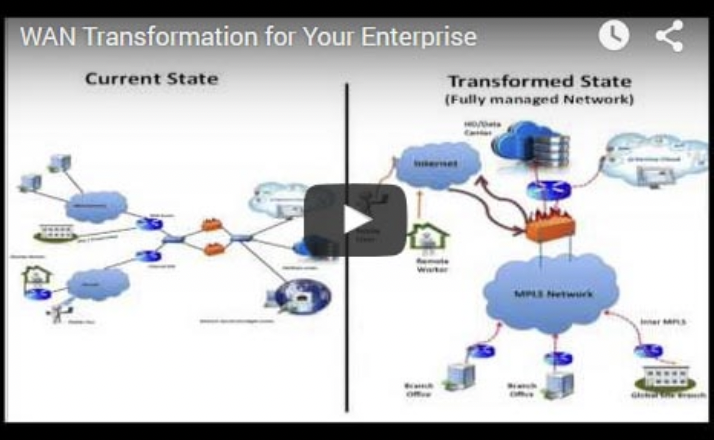
Organizations need to move from using widely disparate and hybrid networks to integrated cloud-enabled networking platforms that can provide seamless manageability, high performance and high degrees of resilience and security. Watch this insightful video on WAN transformation