
Embarking on a successful Microsoft Cloud journey with Sify
In the digital age, migration to Cloud has become the top-most priority for businesses across realms. We are seeing major shift in the number of ‘Cloud Hostile’ customers turning into ‘Cloud Friendly’ & ‘Cloud Ready’ customers and pondering on the best plan to implement the migration successfully.
Know more about Sify’s offerings in the cloud migration services space.
One of the major reasons behind this trend – besides performance, security, and cost – is agility & flexibility which help in faster business innovations. Organizations have started transforming themselves digitally to drive business value and grow business with enhanced end user experience.
Over the past few years, Microsoft has earned massive popularity among organizations worldwide for being a leading Cloud and cloud managed services provider with – Azure, Microsoft 365 (M365) and Microsoft Dynamics 365.
Microsoft Azure is a highly productive, hybrid, and intelligent Cloud that allows you to leverage the power of cutting-edge digital technologies to build, deploy and manage critical applications as per your company’s requirements. It also provides Cloud enhanced services like AI/ML, RPA, Analytics tools, and integrated Cloud resources to make your organization more agile and improve top-line performance.
Learn more about Sify’s capabilities in the Microsoft Azure managed cloud services domain.
Considering the above benefits, many forward-looking businesses are exploring Azure Cloud-powered services and Azure managed cloud services to optimize internal processes and generate new business models. However, this digital aspiration is incomplete without transforming the technology landscape first. A strong technology foundation provided by Microsoft will help you connect your disparate data, processes, users, and applications to accomplish the end objective of organizational excellence.
Achieving all these is not as simple as it may seem initially! That’s where, Sify’s consultative approach and Azure managed cloud services capabilities can help you leverage the true value of Microsoft Services and align your organizational roadmap with the ever-evolving technology landscape.
Explore why Sify ranks high among the leading cloud managed services providers across the globe. Know more about our public, private, multi- and hybrid cloud managed services capabilities.
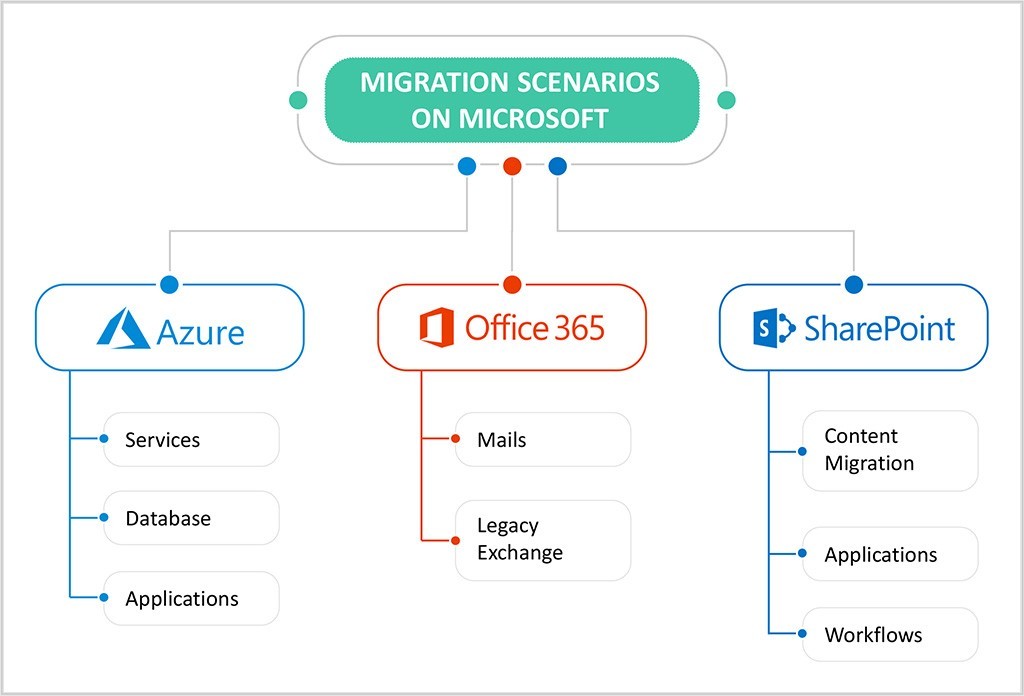
Azure Migration: The most successful path
Different organizations have distinct approach towards Cloud migration and need different types of cloud migration services, and their decisions are governed by business specific priorities and constraints. You must know that Cloud migration services involve significant organizational change management across people, process, and technology. It’s very important to draft a holistic approach to migrate successfully and realize the benefits of efficiency, agility, and cost.
Sify’s cloud migration services for Azure
As a trusted partner among cloud managed services providers globally, Sify offers unmatched capabilities in cloud migration services. With Sify as your strategic partner for cloud migration services, you are perfectly positioned to draft, implement, and monitor the overall migration plan in the most successful way. Our team of Cloud experts, Azure certified professionals, cutting-edge toolchains, and partner ecosystem can help you accomplish migration goals successfully. Our cloud migration services can help you across all three phases of migration – assessment, migration, and optimization.
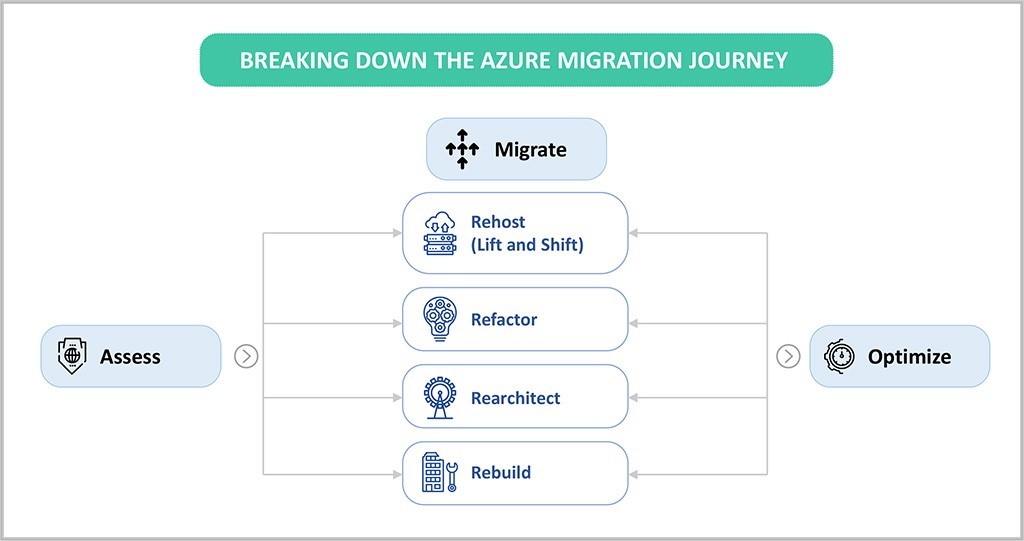
Assessment: This is the first phase of migration journey, which includes assessing and discovering your on-premises apps, data, and infrastructure. Our comprehensive range of cloud migration services and assessment services can help you map dependencies across applications and decide their priority of Azure migration for a seamless journey.
Migration: The actual cloud migration begins in this phase, where you start moving your apps, data and infrastructure – leveraging the best-suited cloud migration services, strategies and tools. Our cloud migration services will help you automate the entire migration journey (depending upon your IT specific needs) and minimize the downtime.
Optimization: Once you have moved to Cloud, it becomes important to monitor your Cloud resources continuously for better performance, enhanced security, and reduced cost. Consistently ranked among the leading cloud managed services providers, our managed services will help you maximize your ROI and leverage unified visibility of Cloud resources for efficient resource utilization and optimization.
Explore how Sify’s cloud migration services bring the assurance of high rates of success. Know more about our public, private and hybrid cloud managed services and migration capabilities.
Sify + Azure Advantage
- Single window solution provider (Network, Security, Azure IT and Management)
- End-to-end Azure service coverage: Access – Architect – Migrate – Manage – Secure
- Integrated Azure network and security proposition
- Unified Dashboard across Azure IT
- Simplified Execution and single point of ownership
Know more about transforming your IT Infrastructure with Sify’s Microsoft Azure managed cloud services capabilities.
Microsoft 365 – Mail migration
With Office 365 becoming the de-facto mode for conducting business, it is important to modernize the underlying infrastructure and platform. It is imperative for enterprises to move their legacy exchange and other mailboxes to Office 365 in order to reap full benefits of their workflow optimizations. Additionally, Office 365 offers the benefit of pay per use pricing for optimizing cost.
So in case, you are exploring the possibilities to conceptualize and implement your cloud migration in the most success-driven manner, Sify can help you embark on a successful Microsoft Cloud journey.
Our Accreditations
- Microsoft Certified Partner for Cloud & Managed Services
- Certified Deployment Partner for deployment of M365 & Azure services
- Express Route Partnership for seamless connectivity with MS Cloud Azure & Microsoft 365
- Certified team for Migration & Deployment of MS SQL workloads
- Certified team for deployment of Hybrid Cloud Platform


Simplified Cloud Adoption for SAP S/4HANA
Let Sify, your Cloud expert manage your SAP Migration

Every transformation journey begins with adoption of digital technologies on Cloud. Forward-looking organizations worldwide are looking for Cloud-powered solutions to attain the highest level of business agility, scalability, and compliance in the most cost-effective way. Additionally, Cloud-powered solutions facilitate access to new generation technologies, such as IoT, AI, and ML, which help you achieve your transformation goals in an outcome-focused manner.

SAP S/4HANA is a modern business solution suite that fosters intelligent innovations, business process improvement, and IT landscape transformation, without any upfront capital investment in infrastructure, database, hardware, etc. Moreover, it comes with pervasive data modelling capabilities and simplified deployment roadmap options.
Cloud adoption for SAP S/4HANA
Powered with Cloud and Analytics, SAP S/4HANA is undoubtedly a comprehensive, intelligent business suite delivering to organizations, unique insights, and intelligence. However, moving to SAP S/4HANA is not as simple as it may seem initially. It is dependent on your insight and capability to fundamentally examine your business processes, infrastructure, and data. Furthermore, you need to reconsider your business objectives and project priorities to achieve seamless migration to Cloud and realize all its benefits.
To evaluate how SAP S/4HANA can benefit your organization, it is always sensible to assess the consumption and configuration of your existing SAP environment. Subsequently, you need to create a migration to Cloud roadmap for seamless technical deployment, depending on project specific requirements, strategic transformation goals, etc.
Irrespective of the approach you choose, be it New Implementation or System Conversion, there are various advisory tools, such as Business Scenario Recommendations, Readiness Check Tool, etc. that can help you gain the necessary insight and confidence to simplify your move to SAP S/4HANA. After gaining clarity, you should continue forward with your S/4HANA adoption on Cloud in a phase-driven manner.
Five phases of successful SAP S/4HANA Cloud journey

Re-evaluate your current stage and develop a vision:
Before you start your Cloud journey, answer the reasons behind it. You need to evaluate your current IT landscape, analyze your business strategy, consider cross-functional dependencies, and develop a strategic vision before moving to SAP S/4HANA. Herein, Business Scenario Recommendations (BSR) for SAP S/4HANA can help you generate a comprehensive report on how your current system would be impacted and how you should prepare adeptly to derive true value propositions.

Explore the value of SAP S/4HANA:
Once you have evaluated your business landscape, you must start exploring all the value propositions of SAP S/4HANA that can help you transform the overall IT landscape and improve business processes. Mapping key business functions is yet another major area you need to consider while analyzing the values of SAP S/4HANA. SAP Innovation & Optimization Pathfinder can help you analyze all the business improvement opportunities. It also provides rich analysis of innovation recommendations, innovation acceleration, and IT optimization.

Future State Design:
During this phase, you need to start focusing on the technical aspects of your migrating specific parts of your IT landscape or processes to SAP S/4HANA. It is always advisable to define processes and IT landscape that you think are suitable for SAP S/4HANA in order to devise a future-ready migration layout. During this phase, organizations count on different tools such as Readiness Check and Maintenance Planner. Readiness Check highlights the required solution adjustments that are needed for system conversion. Maintenance Planner generates the stack file online from SAP marketplace, which is required to download the SAP S/4HANA software.

Migration and roadmap:
Before the transition begins, you need to outline clearly defined migration strategies to identify, evaluate and select the best migration scenario. To attain seamless transformation and successful SAP S/4HANA migration, you must define the strategy that best suits your vision depending on your current IT stage.

Plan S/4HANA Implementation:
The actual transition begins in this phase, and you must embrace a high-level project management approach to successfully migrate to SAP S/4HANA. As majority of organizations lack technical skill, competence, and expertise to implement such a project, it makes good business sense to collaborate with an expert.
Why Sify for SAP migration, infrastructure, and management?
It is important not to get overwhelmed by the adoption complexity, as finding the right partner will alleviate most of your concerns. Sify has a rich experience and all the state-of-the-art tools required for successfully migrating heterogeneous or homogeneous SAP workloads and managing them.
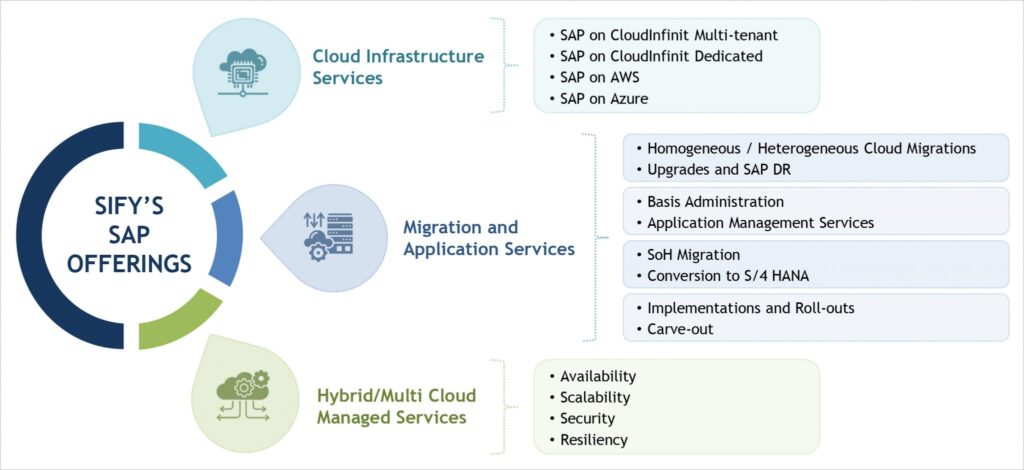
Sify provides you the option of choosing the most appropriate environment for your SAP workloads. You can host your SAP workloads on HANA grid (which is certified by SAP) on Sify’s proprietary Cloud – CloudInfinit. You also have the choice of deploying it on a Hyperscaler (AWS, Azure, etc.) with DR on Sify’s SAP grid or vice versa to leverage the benefits of Hybrid Cloud. Furthermore, we hold a distinct level of specialization in ECC to S/4HANA conversions, implementation and carve out scenarios. Sify’s integrated play across Network, Cloud and SAP ensures that you get flexibility, agility, and choice for comprehensive coverage of all your SAP needs.
Snapshot of Sify’s SAP offerings

Migration to Oracle Cloud: common pitfalls and best practices
Count on Sify to accomplish your migration goals
Enterprises worldwide are in a quest to leverage the true potential of the Cloud. As Cloud allows organizations to unify disparate business functions, streamline processes, enhance organizational efficiency, achieve resilience, and control cost, decision-makers across the business world are looking for the most suitable Cloud and a competent Cloud partner.
Herein, Oracle Cloud has certainly been able to garner attention by helping organizations optimize IT infrastructure, achieve operational excellence, and reduce cost significantly. Oracle ensures a very unique value proposition as it uses the same on-premises products and tools for Cloud. It is built from on-prem deployments, unlike other Cloud providers which started with a Cloud-native approach only. As organizations transition their processes, business functions, or implement a complete transformation to the Cloud, the “integration” between different Cloud and on-premise enterprise applications will be the focus. We know that not all enterprise applications will migrate to the Cloud at the same time, therefore it is imperative that existing on-premise integration is utilized to communicate between the on-premise applications and the Cloud applications via a common cloud integration platform. In such a situation, Oracle certainly ensures distinct advantages.
Oracle is the only cloud provider to offer guaranteed availability, management, and performance SLAs. Moreover, it also ensures greater control and visibility of Cloud resources, which further helps in improving top-line business performance. That’s why organizations are keen to migrate to Oracle Cloud.
However, organizations face distinct challenges and complications while executing the migration plan. As we work with organizations (across verticals) for their Cloud transition or migration projects, we have gained expertise in helping them identify all pitfalls and follow a trusted approach to create and implement successful migration to Oracle Cloud.
This blog highlights the major challenges faced by organizations during their migration journey to Oracle Cloud and the best practices to tackle those challenges. Furthermore, we shall discuss how Oracle Cloud, Sify’s hybrid IT-ready data centers (with Cloud Adjacent and Near Cloud data centers), and Network Services can help you accomplish your Cloud transformation goals competently.
 |
CHALLENGE: Not every workload is Cloud-ready for Lift-N-Shift |
 |
BEST PRACTICE: De-couple the workloads into different categories |
It’s a well-known fact that not all workloads can be migrated to Cloud using the same migration strategies. Therefore, Sify has come up with a comprehensive range of Cloud Assessment Services which help you decouple the workloads into two broad categories – the workload that must be migrated to Oracle Cloud and the workloads that can be hosted in Sify’s Hybrid IT-ready DC. This will help you draft the most appropriate and cost-effective Cloud adoption/migration plan.
|
CHALLENGE: Inter-dependency between applications |
|
BEST PRACTICE: Build migration specific business case for each application |
Sify’s Cloud Assessment and Migration Services help you identify inter-dependency between applications and build migration specific business case considering each application. Our Hybrid IT-ready data centers allow you to establish fast and secure interconnection among all your applications hosted in Oracle Cloud, without any network latency issue.
|
CHALLENGE: How to deal with legacy applications |
|
BEST PRACTICE: Leverage Cloud Integration Platforms for hybrid deployments |
As all enterprise applications cannot be migrated to Cloud due to architectures, dependencies, and cost, there needs to be effective integration between legacy and cloud applications. Sify is uniquely positioned not just with the ability to meet Network SLAs but also with the ability to design, implement and manage hybrid deployments with legacy on-premise applications and the Cloud applications, via a common Cloud integration platform leveraging Oracle technologies.
Count on Sify for a successful migration to Oracle Cloud
Sify complements Oracle’s public Cloud portfolio with its expansive service portfolio encompassing data center services, migration and assessment services, telecom, and managed services. This offers customers a holistic value proposition for their Cloud journey which no other service provider can offer.
With the Oracle Cloud data center co-located with us, Sify is in a unique position to offer customers the advantages of Oracle public Cloud and co-location of partial workloads from the same premises which are interconnected through a high speed, low latency, and highly secure ‘FastConnect’ link. This allows customers to go for their own hybrid data centers without having to worry about latency issues.
With our cloud@core strategy, Hybrid IT-ready Data Centers and Network Services offering <1ms latency for Hybrid deployments, we are the only Cloud Transformation partner that can help you leverage the true potential of hybrid Cloud. Our Hyperscale Cloud and Data Center Services, low latency, high bandwidth, and secure connections to Oracle Cloud ensure better performance at predictable costs. Moreover, our team of competent Cloud experts and Oracle-certified solution architects are willing to offer prescriptive guidance at every stage of your Cloud adoption and transformation, to help you achieve your Oracle migration goals.

How to orchestrate and manage workloads in multi-cloud environments
Multiple business applications of an enterprise are usually housed on-premise and on-cloud infrastructure. In a multi-cloud environment, multiple cloud providers build the IT portfolio, which would mean that the company must manage multiple service level agreements. Technically, this environment provides the enterprise with a workload migration capability between different cloud services on demand, depending upon which is beneficial.
However, if the integration of IT systems on a multi-cloud environment are not tightly coupled, it may lead to various issues. In a hybrid environment, clouds can be interconnected, but in a multi-cloud environment, alternative measures must be taken as there are multiple service providers. Integration and orchestration are the standard measures employed to manage workloads in a multi-cloud environment.
A multi-cloud is not a hybrid cloud
A hybrid cloud would have different models for deployments in public and private clouds, but a multi-cloud environment would have multiple service providers who may be delivering services using the same type of deployment. At an advanced level, the tapestry of a multi-cloud system can contain categories of private cloud, hosted private, hyperscale cloud, and hybrid clouds with each having multiple vendors.
Multi-cloud management is challenging as different clouds may not be interconnected as in a hybrid cloud. This adds complexity to the management of resources, capacities, services, compliances, and finances. For governing resources in a multi-cloud, automation tools are often used. On top of it, orchestration can help streamline the functions of these tools. However, using multiple tools for managing different domains can still be complicated. Deploying automation technologies that can work across environments and help manage assets throughout may be beneficial. This can reduce complexity, enhance performance and strengthen the security of the multi-cloud system.
For the system to be agile and to maximize the value of a multi-cloud system, the workloads on the cloud should be properly mapped to specific types of clouds. This makes orchestration and management of workloads across multiple clouds easier in an integrated system. With this strategy in place, the user need not jump between different provisions while orchestrating between different workloads. Moreover, integration enables a combined visibility of all resources such that their costs, logs, metrices, and performance indicators, can be accessed through single interface in real time.
Managing a multi-cloud system
A standard way to approach multi-cloud management would be to create a blueprint for integration and management, in which strategies can be designed for ITSM integration, database monitoring, business process analysis, patch management, and life cycle management. An example of a strategy would be the standardization of resource consumption. A company can standardize the consumption patterns of resources based on the type of cloud and the service provider. For instance, one service provider may be used only for data analytics while others would serve the storage necessities, and a third would be used to work for Artificial intelligence applications.
To be able to manage this multi-cloud environment efficiently, a company needs to have an integrated system of resources. Integration makes it possible to monitor all the available resources, which is essential for the effective functioning of a multi-cloud system. Monitoring enables visibility into cloud networks, specific applications, and even potential threats faced by components of the cloud infrastructure.
Companies cannot take a traditional approach to manage the multi-cloud systems because unlike the earlier environments; resources are not homogenous in a multi-cloud environment. A managed multi-cloud in silos with individual tools can be both difficult and costly. Agility and flexibility of a multi-cloud system cannot be ensured if the complexity persists. Integration can help address such issues by making a multi-cloud system appear like a single system.
For effective management, the integration should be carried out along six dimensions: organization, business, processes, governance, information, and tools. After integration, an IT administrator can use a single interface to access all resources and take required actions for managing them.
Specific applications can be bundled within containers for the ease of maintenance. This packaging also increases the portability of applications as they separate the applications from their runtime environments. The apps within a container can easily be moved between cloud services while retaining their functionality. Based on individual criteria such as cost, availability, and storage space, the organization can freely select a cloud service provider. Containers are particularly ideal for a microservices environment in which software is built in such a way that the applications are broken down into very small components that are easily portable.
A managed multi-cloud service-based environment can always provide agility and a higher level of flexibility when compared to traditional approaches. Orchestration and integration are the keys to successful management of a multi-cloud environment. Orchestration can streamline automation, reduce complexities, enhance performance, and improve security. With integration comes visibility while containerization enables portability and easy maintenance.
Sify’s many enterprise-class cloud services deliver massive scale and geographic reach with minimum investment. We help design the right solution to fit your needs and budget, with ready-to-use compute, storage and network resources to host your applications on a public, private or hybrid multi-tenant cloud infrastructure.
How to orchestrate workloads between public and private clouds
Imagine how an orchestra combines a multitude of instruments to create a symphony. In the same way, a hybrid cloud orchestrates, skillfully combining public and private cloud, to create a seamless cloud infrastructure. As multiple applications on a public–private hybrid infrastructure could add to complexities, with the help of orchestration, a centralized structure can be created to allow management of multiple applications using a single interface. Differences in bandwidths, workloads, and access controls can all be managed by this orchestration software.
Integration of different technologies in a hybrid infrastructure determines how effective the orchestration is. For seamless integration, the compatibility between different systems and applications must be ensured, so that orchestration of workloads between public and private clouds is seamless, providing the needed high-performance compute. In the absence of orchestration, enterprises using a hybrid cloud would be forced to manage the public and private clouds in silos, which can put pressure on their resources and demand additional overheads. In addition, orchestration provides the benefit of streamlining resources for coordination, making it easier to manage multiple workloads.
Orchestration on the Private Cloud
A private cloud may not be cheap, but it brings its advantages. It gives greater control over assets and provides enhanced cloud security, resiliency, and flexibility to the system. With private cloud orchestration, automation of the infrastructure could be managed, by establishing workflows that work without human intervention. While private cloud automation would initiate processes automatically, orchestration results in a unified structure of workflows. In this arrangement, resources can be provisioned as needed to optimize the workloads on a private cloud. Thus, an organization can realize savings in engineering time, and IT costs.
What does orchestration involve?
Orchestration enables a coordinated deployment of automation services on the cloud. Cloud orchestration happens at three levels: resource, workload, and service. At the resource level, IT resources are allocated, and at workload level, they are shared. At the service level, services are deployed so that shared resources are optimally utilized. While individual automation only takes care of a single task, orchestration automates end-to-end processes. It is similar to creating a process flow that automates the sequence of automation. The workflows created in the process enable technologies to manage themselves. There are many orchestration tools available in the market that can be used by organizations based on their individual requirements. Some popular tools are Chef, Puppet, Heat, Juju and Docker. Chef is used at OS level while Puppet is more popular at middleware level. Heat is an orchestration method developed from OpenStack, and it can orchestrate everything in OpenStack. Juju is used at the service level while Docker serves both as a tool for orchestration and technology for virtualization.
Workload placement considerations
In a hybrid cloud, both public and private applications generate different workloads. To manage these workloads, and handle their seamless switch between public and private cloud infrastructure, an appropriate cloud strategy is needed. Distributing the workload between different IT assets is a business decision in which regulatory compliance requirements, trade-offs, business risks, cost, and growth priorities are taken into consideration. For instance, certain countries like China may have certain federal restrictions on the use of the internet for which a private WAN can be deployed. The cost could be a concern for an organization looking to provide last-mile connectivity if private cloud is deployed, but with public infrastructure used for addressing service needs of remote locations, cost savings can be realized. A private or hybrid cloud may require establishing an in-house team for IT support while public cloud can work without any, and with limited, cloud expertise in-house.
Technical parameters such as data volume, performance, security, and integration are considered when orchestrating workloads between different cloud deployments. Based on the level of importance each of these attributes carries, workloads can be shifted between the public and private cloud. Public clouds could be deployed for workloads that require a higher level of security but a lower level of integration and performance, such as CRM and information systems. When a continuous demand for a higher level of integration arises, an organization may have to add a private cloud to the IT infrastructure. Workloads like file printing, networking, and systems management may work with either nature of the cloud. However, if data volumes grow, the public cloud would not suffice, and the organization should orchestrate to a private cloud. Applications like enterprise resource planning, data marts, and Big Data analytics make use of high volumes of data that need a private cloud to manage.
A true hybrid cloud allows for easy migration of workloads between public and private clouds. It is always wise to develop a hybrid cloud strategy depending upon workloads, as portability of workloads becomes possible and traditional applications can be bridged with modern applications across the cloud infrastructure. When cloud deployments are planned based on the changing needs of the workloads using orchestration, the enterprise can make their IT infrastructure more optimized, flexible, and adaptive.
Sify’s many enterprise-class cloud services deliver massive scale and geographic reach with minimum investment. We help design the right solution to fit your needs and budget, with ready-to-use compute, storage and network resources to host your applications on a public, private or hybrid multi-tenant cloud infrastructure.

Five ways cloud is transforming the business world
Organizations around the globe are inclining towards the cloud technology and cloud platforms for enhanced data management and security, cost-efficient services, and of course, the ability to access distributed computing and storage facilities from anywhere, anytime.
In a recent study it was found that nearly 41% of the surveyed respondents showed interest in investing in and increasing the spending on cloud technologies, with over 51% large and medium companies planning to expand their budgets for cloud tech. As a result of this rapidly increasing interest and demand for cloud-based services, cloud computing service providers and cloud computing companies are on the rise.
But, why is the business world rapidly shifting to the cloud computing?
Cloud computing can bring about major positive transitions for businesses as it offers grounds for innovation coupled with organizational efficiency. Let’s look at the five ways in which cloud computing is transforming the business world.
1. Enhanced Operations
One of the best features of cloud computing solutions is that they can scale as a company grows. Cloud computing service providers allow companies (big or small) to move a part or all of their operations from a local network to the cloud platform, thereby making it easier for them to access a host of facilities such as data storage, data processing, and much more. Usually, cloud computing service providers have a strong and dedicated support team that can assist users through real-time communication.
Another major benefit of using a third-party service is that the responsibility of data and system management and the associated risks falls under the purview of the service provider. So, one can take advantage of the cloud services without having to worry about the risks.
2. Cost Reduction
Cloud computing services are highly cost-effective. Companies and businesses using the services of third-party cloud computing providers need not bear extra expenses in setting up the required infrastructure or hire additional in-house IT professionals for installing, managing, and upgrading the systems. As mentioned above, all these needs are taken care of by the cloud computing providers. Also, small companies can take advantage of the same tools and resources that are used by large corporations, without having to incur additional IT overhead. This means cloud computing services can reduce IT costs and increase the operating capital which can be steered towards improving other core areas of the business. With increased productivity, efficiency, flexibility and reduced costs, businesses can become more innovative and agile in their operations.
3. Fortified Security And Storage
Unlike the past, cloud computing service providers are now extremely cautious about the security and safety of their users. All the sensitive user data, files, and other important documents are stored across a distributed network. Since the data is never stored in one single physical device and the enforcement of encrypted passwords and restricted user access, the safety and security of the user data are enhanced. Steps are taken to further protect the data by incorporating firewall and anti-malware software within the cloud infrastructure.
Furthermore, cloud computing service providers allow businesses to leverage the best quality hardware for faster data access and exchange. This further boosts the operational efficiency, speed, and productivity.
4. Improved Flexibility
With cloud services, employees can access the same resources while working remotely that they could access while working from the office. Thanks to cloud technology, employees can now work within the comfort zone of their homes and get work done seamlessly. Mobile devices make this even more convenient by allowing employees to enjoy the flexibility of working at their own pace while also facilitating real-time communication between them and the users. Cloud companies can, thus, deliver better and more efficient services by investing in a band of dedicated remote employees instead of maintaining a full-house of on-site employees. This fast increasing mobile workforce delivering quality cloud solutions is a big reason why businesses today are making the transition to cloud computing providers.
5. Better Customer Support
Today, cloud computing providers have upgraded their game by offering an array of support options for businesses to choose from. Apart from the conventional telephone service, businesses can now opt for AI-powered chatbots that can interact with customers like a real human being. As most cloud computing providers offer impressive bandwidth, it facilitates improved communications which allow a firm’s customer support team to handle customers requests swiftly. The speedy and prompt delivery of support services will ensure that the customers don’t have to wait for hours for their queries/requests to be addressed. All this together leads to a richer customer support experience.
The end result? Happy customers who endorse the brand to a larger network.
Cloud computing is a versatile platform that offers an extensive variety of solutions to the common challenges and hurdles that businesses face in their day-to-day functioning. And that is precisely why cloud computing solutions and services are increasingly penetrating the business world by the minute and transforming it for the better.
Opt for dedicated private cloud infrastructure services for your mission-critical workloads.
To learn more about SIFY’S GOINFINIT PRIVATE – an enterprise-grade, fully integrated private cloud IT platform with specific controls, compliance and IT architecture available in a flexible consumption model.

What Are the Trending Research Areas in Cloud Computing Security?
Cloud computing is one of the hottest trends. Most technological solutions are now on cloud and the ones remaining are vying to be on cloud. Due to its exceptional benefits, it has magnetized the IT leaders and entrepreneurs at all levels.
What is Cloud Computing?
Cloud Computing is when many computers are linked through a real-time communication network. It basically refers to a network of remote servers that are hosted in Data Center, which further can be accessed via internet from any browser. Hence, it becomes easy to store, manage, and process data as compared to a local server or personal computer.
What is Cloud Networking?
The access to the networking resources from a centralized third-party provider using Wide Area Network (WAN) is termed as Cloud Networking. It refers to a concept where the unified cloud resources are accessible for customers and clients. In this concept, not only the cloud resources but also the network can be shared. With Cloud Networking, several management functions ensure that there are lesser devices required to manage the network.
When data began to move to cloud, security became a major debate, but cloud networking and cloud computing security has come a long way with better IAM and other data protection procedures.
Cloud networking and cloud computing security revolves around three things-
- Safeguarding user accounts in the cloud
- Protecting the data in the cloud
- And, then the third aspect is application security.
Trending Research Areas in Cloud Computing Security
Following are the trending research areas in the Cloud Computing Security:
- Virtualization: Cloud computing itself is based on the concept of virtualization. In this process, virtual version of a server, network or storage is created, rather than the real one. Hardware virtualization refers to the virtual machines that can act like a computer with an operating system. Hardware virtualization is of two types: Full Virtualization and Para-Virtualization.
- Encryption: It is the process of protecting data by sending it in some other form. Cloud computing uses advanced encryption algorithms in order to maintain the privacy of your data. Crypto-shedding is another measure in which the keys are deleted when there is no requirement of using the data. There are two types of encryption used in cloud computing security including Fully Homomorphic Encryption and Searchable Encryption.
- Denial of Service: It is a type of attack in which an intruder can make the resources of the users unavailable by disrupting the services of the internet. The intruder makes sure that the system gets overloaded by sundry requests and also blocks the genuine incoming requests. Application layer attack and Distributed DoS attack are some of its types.
- DDoS Attacks: It stands for Distribution Denial of Service. It is a type of Denial of Service attack in which hostile traffic comes from various devices. Hence, it becomes difficult to differentiate between the malicious traffic and the genuine one. Application layer DDoS attack is another type of DDoS attack in which the attacker targets the application layer of the OSI model.
- Cloud Security Dimensions: Software called Cloud Access Security Brokers (CASB) in between the cloud applications and cloud users, monitors all the policies related to cloud security and also enforces the cloud security policies.
- Data Security: The Encryption method is used in protecting and maintaining the privacy of the data because security in the cloud-based services has always been the focal point. Due to some vulnerabilities and loopholes, data might get exposed to the public cloud.
- Data Separation: An important aspect of data separation is the geolocation. Organizations should make sure that the geolocation for data storage must be a trusted one. Geolocation and tenancy are the major factors in data separation.
Cloud is one of the topics with no limit at all. With its help, you can perform any kind of project in order to enhance the performance in speed and magnify the security algorithm so as to prevent the files from being hacked.
Sify allows enterprises to store and process data on a variety of Cloud options, making data-access mechanisms more efficient and reliable.

Key Advantages Dedicated Web Server Hosting
Are you in search of the best application hosting? Well, choosing the best-dedicated server for your enterprise could be a task in itself. But why dedicated web server? A dedicated web server ensures resilience and resources to host a web application.
Selecting a dedicated server which is fast, secure, properly managed, and has the perfect software tools is very much essential for the growth of your business. A company looking forward to having more control and power will opt for a service provider who offers dedicated server hosting. The server is built and maintained by the provider, thus cutting down the cost of purchasing your own server.
So, let us take a sneak peek into the advantages of choosing a dedicated server hosting provider and some other useful tips in getting started with your new dedicated server.
Advantages:
- High Performance and SecurityHow can you maximize the uptime for your website or application? It is through a dedicated hosting provider. Dedicated servers provide more reliability and stability than the shared hosting. It makes sure that you are not sharing your space with any other malicious software or a potential spammer. Dedicated server leads to enhanced security, this is the reason it is essential for companies taking transactions over FTP or SSL. Moreover, the best-dedicated server hosting comes with 24×7 support to deal with failures and complaints which further ensures high uptimes.
- FlexibilityA dedicated server comes up with flexibility, as you can always customize your server as per client’s requirements of RAM, disk space, CPU, and software. If you want a customizable server environment, then a dedicated server might fit your needs.
- Server Resources are not sharedChoosing a dedicated server fetches you all the resources of a server. With a dedicated server, your server won’t slow down, as there are no other applications sharing your space and clogging up the server’s RAM and CPU. In case of dedicated hosting, your server bandwidth is only yours.
- No Purchase and MaintenanceIf a company requires a dedicated hosting, and it does not have the time and resources to manage a server, the dedicated hosting is a low-cost way to access the resources of the server. Dedicated server hosting helps in maintaining the server equipment, thus reducing the overhead for a business.
- Full ControlOne of the most widely held benefits of dedicated hosting is that you have full control on your server. You decide which site management tool and application you wish to deploy, provided your hosting provider can service them.
Factors to Consider while Purchasing Best Dedicated Server Hosting Plan
Developers and business owners try to find the best-dedicated server hosting because they can be configured easily in order to quench the programming requirements, server load support, and top-notch security. So, here are the points which should be kept in mind before purchasing a dedicated server hosting plan:
- Different types of RAM- Primarily used is DDR3, DDR4, and ECC options in present
- Focus on CPU Benchmark Performance- Know the difference between Xeon, Atom, and Opteron product lines
- Choice of Bandwidth and Data Center Concerns- Internet Backbone Network Speeds, Power Supply, and Cooling
- OS- Windows and LINUX; and choosing between different LINUX distributions
- Technical Support- the capability to support your clients
- Disk Drive Storage- HDD vs Solid State Drives (SSDs)
Almost all the users of dedicated servers yearn for the best hardware configurations at the lowest possible price. However, some choose to bargain on the older equipment available at a particular discount. Legions of mobile applications that come with custom code require complex web server that shared hosting plans do not support. However, it is advised that the business owner should consult with their system administrator to discover the development requirements for their productive applications. Novice development in cloud hosting may soon have an upper hand over the dedicated server plans, and cheaper cum better plans are available on VPS plans with more resource allocation. Hence it becomes quintessential, as how to keep your online business up to date in a rapidly innovating web hosting industry.
Focus on your core business and outsource the complexities of Data Center management with Sify

The trends and technologies shaping the future of Contact Centers
Contact Centers are in a state of constant evolution! With customer engagement rated as one of the most critical factors for the success of a product or service, businesses are striving to perfect the customer care scenario every single day. In this race to keep customer loyalty, companies are turning to technology to deliver exceptional customer service.
In the last couple of years, to keep up with the changing needs and behavior patterns of buyers, Contact Center technology has evolved considerably. We take a closer look at some of the latest trends in the field.
The trends and technologies shaping the future of Contact Centers
Digital Transformation of Customer Services
The digital way of working has now been fully embedded into the business operations of most companies. As newer technologies such as cloud, web based applications, mobility, and data analytics change the business landscape they also have an impact on how contact centers are operated. Adoption of these technologies, especially the move to cloud platforms, has resulted in altering the entire cycle of customer engagement – from dealing with the first client contact occurring across multiple channels to providing intelligent, data analysis backed the resolution to customer issues.
Omni channel Models
From traditional phone calls to social media messages – Customers are using a variety of communication channels to approach businesses. Needless to say, businesses are also turning to a more holistic customer engagement approach that uses unified Omni-channel communication models – bringing text, phone, chat, email, social, video calls, etc. under one umbrella – to provide a more personal and satisfying experience to the customer.
Analytics and Customer Satisfaction
To consistently deliver exceptional customer experiences, businesses need to consider more than the final resolution of the customer requirement; it is imperative to keep a check on the customer experience during the journey towards resolution and overall quality of the calls. This can be achieved by using analytical tools to improve the Contact Center operations. Customer care centers are using real time reports and monitoring solutions to keep a check on engagement quality and are also incorporating cutting edge analytical tools to study behavioral patterns in speech, text or chats to predict customer behavior.
Remote agents
With reliable web based communication tools and access to real time monitoring Contact Centers are now employing more and more remote agents; thereby efficiently managing different time zone requirements while reducing overhead costs.
Artificial Intelligence
AI, the latest buzzword in the IT landscape, is now being tested and incorporated in Call centers as well. AI algorithms are mainly being used to analyze call data and historical records to foretell customer behavior – producing dependable results in minutes, something that would have taken an analyst days to complete. AI technology is also being explored to place virtual call agents to handle some of the more repetitive and simpler customer interactions.
Going ahead, companies and consumers alike will be putting more and more emphasis on customer care as a brand differentiator rather than as a support function. Although recruiting and training agents form a vital part of call center operations; to stand out companies are exploring technology integrations to make their operations more efficient. And while technologies like Artificial Intelligence are still being developed and implemented, sophisticated cloud based offerings such as CCaaS (Contact Center as a Service) are proven models, which bring an added level of productivity with enormous cost benefits to traditional Contact Centers.
As India’s leading fully converged ICT Company, Sify is using its decades of experience in network and Data Center services to present the most comprehensive Contact Center as a Service platform in India.
Our extensive expertise has allowed us to craft a service offering, which is highly flexible, scalable and future proof. Sify’s CCaaS provides all Contact Center applications under one umbrella-from branch connectivity and video conferencing to 100 % reliable voice calls. Delivered via the cloud, Sify’s CCaaS is a multi channel platform, which can easily meet the most exacting contact center requirements.

3 Key Benefits of taking your contact center to the cloud (CCaaS)
The key to thrive in a “Customer is the King” economy is being extremely responsive to their ever-evolving demands while serving as a pacesetter for the competition. Customers are demanding a wider choice of contact channels, stronger relationships, flexible customer service options and quick-to-respond customer service. All these factors have increased the pressure on Contact Centers; they must deliver the best possible customer experience – consistently!
Organizations are progressively moving towards ‘as a service’ technologies as they look for models that are flexible and enable better responsiveness and service quality in today’s customer centric environment. Contact center service providers’ cloud-based offerings focus on cloud as a deployment option as against the conventional on-premise alternative. By taking the contact center to the cloud, businesses get a robust, flexible, cost-effective and multi-channel solution with unified delivery and professional management.
3 main Benefits of Cloud-based Contact Centers
Flexibility and Scalability
A traditional contact center is based on the intended contact service agent capacity, the approximated volume of customer interactions and an estimate of the type of channel/feature access required. On the other hand, cloud solutions enable businesses to operate fluid contact center operations, where they could modify the scale of operations, swiftly add functionalities, switch the mix of communication channels, handle unanticipated spikes in the interaction volume or draw on enterprise resources. Flexibility and scalability afford unlimited possibilities almost instantly to the businesses without the prohibitive expense of additional infrastructure/related software and the associated time to implement and operate the revised operations.
Substantial Cost Savings
Cost arguments in favor of cloud solutions versus traditional Data Centers are apparent right from the start – the former helps transfer the financial load from CAPEX (Capital Expense) to OPEX (Operating Expense). Switching to an OPEX model brings with it more simplicity and predictability with a ‘pay-as-you-go’ model. It eliminates the challenge and risk of making large capital expenses towards infrastructure at one given point; making it easier to budget for growth. In comparison, non-cloud contact centers cannot achieve this desired flexibility without investing a sizeable amount in infrastructure and are unable to facilitate businesses to right-size their operations. Cloud solutions are cash flow friendly as recurring costs are coupled only with an associated growth spike, thus eliminating the risk of unutilised investment. It also allows better budgeting, planning and related staffing decisions resulting in increased efficiency and productivity
Streamlined IT
Software-as-a-Service (SaaS) has been an industry norm for core applications like email/ CRM and many other business applications and is increasingly becoming universal. Cloud solutions guarantee that bandwidth, network and other communication services are addressed in order to meet evolving business needs and adapt to rapid changes in the business. The cloud-based contact center solution is hosted in a secure and reliable environment, as a result saving time and allowing businesses to focus their energies on their operations. There is an additional benefit of 100% reliable backup and disaster recovery of data and applications, which is difficult and expensive to implement and execute at a smaller scale. Taking their contact center to the cloud provides the businesses with an assured level of business continuity and the option of long-term retention of the data in their contact center operations. Leaders are becoming progressively more interested in the cloud adoption in this model and the operational agility benefits that it provides.
One constant for the contact centers is their relentless pursuit of change for the better. They are continually looking for superior technology, more efficient processes, and better-trained resources in order to improve the quality of the customer experience. These are aimed at serving customers more effectively and at the same time more economically. As providing exceptional one-on-one service, regardless of the medium, becomes the norm for businesses; cloud solutions for the contact centers serve the need of the hour by making it affordable to provide customer experiences designed to make buyers loyal to the brand.
As India’s leading fully converged ICT Company, Sify is using its decades of experience in network and Data Center services to present the most comprehensive Contact Center as a Service platform in India.
Our extensive expertise has allowed us to craft a service offering, which is highly flexible, scalable and future proof. Sify’s CCaaS provides all Contact Center applications under one umbrella – from branch connectivity and video conferencing to 100 % reliable voice calls. Delivered via the cloud, Sify’s CCaaS is a multi channel platform, which can easily meet the most exacting contact center requirements.