Enabling highly effective oncology patient-care
Full-services model enabling 1.75 lacs+ radiation treatment plans prepared on 100% available high-performance cloud platform
Project Objective
Enabling medical Information and treatment application on private cloud.
Project Model
Fully Services Model
Sify’s Uniqueness
Integrated value proposition built on: Private Cloud + Network Services + Managed Services
Integrated Value and Outcome
With the Cloud@core portfolio, Sify dramatically increased the availability of the expensive linear accelerator machines used to administer radiation to cancer patients. This has led to transformational changes in the treatment of cancer patients.
Value for client
- 1.75 lacs+ radiation treatment plans prepared on 100% available high-performance cloud platform
- Decoupled the Patient Oncology Information System from on-premise colocation with linear accelerators
- Patient can choose to go to any of the networked hospitals.
- Experts can remotely access the just-in-time patient condition and swiftly program the system to administer the most appropriate radiation treatment.
- The time to create the radiation plan has been reduced dramatically by pooling of compute resources on the cloud.
- Patient records are permanently archived.
- Streamlined operations with remote change management


New revenue streams and improved patient care through cloud
Leading healthcare provider achieves 33% costs reduction by deploying healthcare app on Sify Cloud
Project Objective
Deployment of client application on Sify Cloud Platform to achieve digital initiative goals and increased revenue.
Project Model
Fully services model (vis-à-vis existing capex + services model)
Sify’s Uniqueness
Integrated value proposition: Private Cloud + Network Services + Disaster Recovery Services + Managed Services
Integrated Value and Outcome
cloud@core products and services:
- Started with hosted virtualization and Managed Services several years ago in first-generation initiatives.
- Migrated to Sifycloudinfinit with Cloud@core in second generation initiatives with minimal disruption
- DRaaS from Cloud@core is configured to mitigate the risk from unplanned disaster to prevent impacting the business
- Hyperreach network connectivity for all hospitals with the enterprise cloud
- Hybrid security and Managed Services for all applications
Value for client
Client could provide better patient care and create new streams of revenue. As a one stop IT infrastructure partner Sify helped rationalize costs and release funds for modernization.
Best Practices for Successful Migration to SAP S/4HANA (On-prem or Cloud)
SPEAKERS:
Prashant Pimpalekar, Sr. VP SAP Practice, Sify Technologies, will be the key speaker along with a SAP Cloud Specialist Shagun Maheshwari, Customer Solution Architect for Cloud ERP, SAP.
DATE:
17th September, 2019
TARGET AUDIENCE:
Any customer evaluating SAP S4/HANA or Cloud Migration services.
DESCRIPTION:
SAP S4/HANA brings in the agility & flexibility to leverage OLAP (On Line Analytical Processing) along with the traditional OLTP (On Line Transaction Processing), reducing data footprint by more than 1/10th.
The webinar will cover both migration options, on-premise and cloud, in detail.
Compelling reasons for enterprises to implement SAP HANA
A look at the top transformational functionalities offered by the platform that present a compelling business case for any CIO.
The world is caught up in the middle of a data explosion.Fueled by technology, a mind-boggling 15 Petabytes of data is created each day. And this is not all.With the emergence of Internet of Things (IoT),the quantum of data getting generated is expected to jump manifold in the near future.
Download whitepaper
Building new revenue streams in patient care
Sify’s private cloud, network, DR and integration services help healthcare major to rationalize costs and release funds for modernization
Project Objective
Deployment of client’s application on Sify Cloud Platform to achieve digital initiative goals and increased revenue.
Project Model
Fully services model (vis-à-vis existing capex + services model)
Sify’s Uniqueness
Integrated value proposition: Private Cloud + Network Services + Disaster Recovery Services + Managed Services
Integrated Value and Outcome
Cloud@core products and services:
- Started with Hosted Virtualization and Managed Services several years ago in first-generation initiatives
- Migrated to SifyCloudInfinit with Cloud@core in second-generation initiatives with minimal disruption
- DRaaS from Cloud@core is configured to mitigate the risk from unplanned disaster to prevent impacting the business
- Hyperreach network connectivity for all hospitals with enterprise cloud
- Hybrid Security and Managed Services for all applications
Value for client
The client could provide better patient care and create new streams of revenue. As a one-stop IT infrastructure partner, Sify helped rationalize costs and release funds for modernization.

Integration of cloud, DC and DR
Resilient and integrated IT infrastructure on private cloud, with hosted IT and automated DR helps insurance leader roll out new solutions rapidly, with 10% reduced TCO
Project Objective
Consolidate four data center application workloads and build Managed Private Cloud and DR Services at Sify DC
Project Model
Fully services model (vis-à-vis existing capex + services model)
Sify’s Uniqueness
Integrated value proposition: Cloud Assessment Services, designed a private cloud architecture using Sify CloudInfinit CMP best practices, automated DR on Sify DRaaS model, Telecom Services for DC-DR connectivity, and end-to-end Managed IT Services
Integrated Value and Outcome
Cloud@core products and services:
- Design, build and deploy Hosted Private Cloud Infrastructure.
- Study and migrate close to 20 applications to hosted private cloud with near-zero downtime window.
- Set up DR at a different seismic zone using DRaaS to provide granular data recovery time objectives.
- Implement security framework to comply with the insurance Industry Regulatory Requirements.
- Managed Services using Sify Managed Services Platform covering DC, DR, Branch Network and Security
Value for client
Resilient IT Infrastructure to roll out new solutions at a rapid rate without delays in procurement of new hardware, software and other IT Infrastructure resources with 10% reduction on TCO YoY.

Performance Matters
SPEAKERS:
Srinivas Padmanabharao, Director of Product Marketing APJ – Akamai
DATE:
Thursday, November 26, 2015
DESCRIPTION:
The ubiquity of mobile devices and proliferation of WiFi has radically transformed customer behavior. Do you understand what customers expect from their online experiences? Do you know what the challenges in delivering to this expectation are and how organizations around the world are dealing with this challenge? Find out in this webinar.

SAP Migrations to AWS Cloud using Cloud Endure Migration Tool
Enterprises migrating SAP workloads to AWS are looking for an as-is migration solution that is readily available. Earlier, enterprises used the traditional method of SAP backup and restore for migration or AWS-native tools such as AWS Server Migration Service to perform this type of migration. CloudEndure Migration is a new AWS-native migration tool for SAP customers looking for assistance with cloud migration services. It is a SaaS service offering from AWS to migrate workloads from any source (physical, virtual, or private/public cloud) to AWS, from one AWS region to another AWS account, and across different AWS accounts. Know more about how CloudEndure enhances our cloud migration services.
Enterprises looking to host a large number of SAP systems onto AWS can use CloudEndure Migration without worrying about compatibility, performance disruption or long cutover windows. You can perform any re-architecture after your systems start running on AWS.
Explore why Sify is ranked among the leading cloud managed services providers globally and our proven expertise in cloud migration services. Click here.
SAP to AWS Cloud Migration Services – Solution Overview
CloudEndure Migration simplifies, expedites and reduces the cost of such migrations by offering a highly automated as-is migration solution. This blog demonstrates how easy it is to set up CloudEndure Migration and the steps involved in migrating SAP systems from source to AWS environment.
Learn more about our cloud migration services and cloud managed services. Click here.
CloudEndure Migration Architecture
The following diagram shows the CloudEndure Migration architecture for migrating SAP systems.
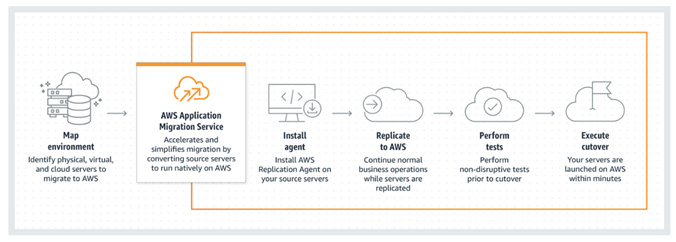
Major steps for this migration are as below:
- Agent Installation
- Continuous Replication
- Testing and Cutover
CloudEndure helps you overcome the following migration challenges effectively:
- Diverse infrastructure and OS type
- Legacy application
- Complex database
- Busy continuously changing workloads
- Machine compatibility issues
- Expensive cloud skills required
- Downtime and performance disruptions
- Tight project timelines and limited budget
Read more about our expertise in cloud migration services. Click here.
SAP to AWS Cloud Migration Services – Use Cases
The most common uses cases for CloudEndure Migration are:
- Lift and Shift, then optimize
- Vast majority of Windows/Linux servers when agent can be installed on source machine
- Replicating Block Storage devices like SAN, iSCSI, Physical, EBS, VMDK, VHD
- Replicating full machine/volume
Benefits of AWS Application Migration Services integration
Access to advanced technology
Simplify operations and get better insights with AWS Application Migration Services integration with AWS Identity and Access Management (IAM), Amazon CloudWatch, AWS CloudTrail, and other AWS Services.
Minimal downtime during migration
With AWS Application Migration Service, you can maintain normal business operations throughout the replication process. It continuously replicates source servers, which means little to no performance impact. Continuous replication also makes it easy to conduct non-disruptive tests and shortens cutover windows.
Reduced costs
AWS Application Migration Service reduces overall migration costs as there is no need to invest in multiple migration solutions, specialized cloud development, or application-specific skills. This is because it can be used to lift and shift any application from any source infrastructure that runs supported operating systems (OS).
Conclusion
This blog discussed how Sify can help its SAP customers migrate to AWS Cloud using CloudEndure tool. Sify would be glad to help your organization as your AWS Managed Services Partner for a tailor-made solution involving seamless cloud migration services experience and for your Cloud Infrastructure management thereafter.
CloudEndure Migration software doesn’t charge anything as a license fee to perform automated migration to AWS. Each free CloudEndure Migration license allows for 90 days of use following agent installation. During this period, you can start the replication of your source machines, launch target machines, conduct unlimited tests, and perform a scheduled cutover to complete your migration.

Automated Recovery of SAP HANA Database using AWS native options
This blog exclusively covers the options available in AWS to recover SAP HANA Database with low cost and without using native HSR tool of SAP. With a focus on low costs, Sify recommends choosing a cloud native solution leveraging EC2 Auto Scaling and AWS EBS snapshots that are not feasible in an on-premises setup.
Solution Overview
The Restore process leveraging Auto Scaling and EBS snapshots works across availability zones in a region. Snapshots provide a fast backup process, independent of the database size. They are stored in Amazon S3 and replicated across Availability Zones automatically, meaning we can create a new volume out of a snapshot in another Availability Zone. In addition, Amazon EBS snapshots are incremental by default and only the delta changes are stored since the last snapshot. To create a resilient highly available architecture, automation is key. All steps to recover the database must be automated in case something fails or goes wrong.
Autoscaling Architecture
The following diagram shows the Auto Scaling architecture for systems in AWS.
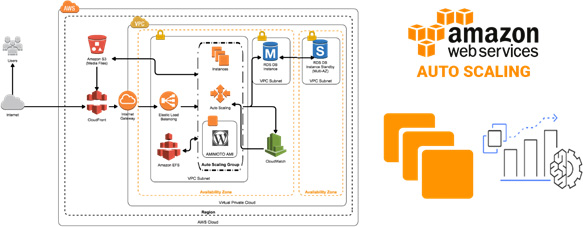
Use Case
EBS Snapshots
Prior to enabling EBS snapshots we must ensure the destination of log backups are written to an EFS folder which is available across Availability Zones.
Create a script prior to the command to be executed for an EBS snapshot. By using the system username and password, we make an entry into the HANA backup catalog to ensure that the database is aware of the snapshot backup. We use the snapshot feature to take a point in time and crash consistent snapshot across multiple EBS volumes without a manual I/O freeze. It is recommended to take the snapshot every 8-12 hours.
Now the log backups are stored in EFS and full backups as EBS snapshots in S3 and both sets are available across AZs. Both storage locations can be accessed across AZs in a region and are independent of an AZ.
EC2 Auto Scaling
Next, we create an Auto Scaling group with a minimum and maximum of one instance. In case of an issue with the instance, the Auto Scaling group will create an alternative instance out of the same AMI as the original instance.
We first create a golden AMI for the Auto Scaling group and the AMI is used in a launch configuration with the desired instance type. With a shell script in the user data, upon launch of the instance, new volumes are created out of the latest EBS snapshot and attached to the instance. We can use the EBS fast snapshot restore feature to reduce the initialization time of the newly created volumes.
If the database is started now (recently), it would have a crash consistent state. In order to restore it to the latest state, we can leverage the log backup stored in EFS which is automatically mounted by the AMI. Additional Care to be taken so that the SAP application server is aware of the new IP of the restored SAP HANA database server.
Benefits
- Better fault tolerance – Amazon EC2 Auto Scaling can detect when an instance is unhealthy, terminate it, and launch an instance to replace it. Amazon EC2 Auto Scaling can also be configured to use multiple Availability Zones. If one Availability Zone becomes unavailable, Amazon EC2 Auto Scaling can launch instances in another one to compensate.
- Better availability – Amazon EC2 Auto Scaling helps in ensuring the application always has the right capacity to handle the current traffic demand.
- Better cost management – Amazon EC2 Auto Scaling can dynamically increase and decrease capacity, as needed. Since AWS has pay for the EC2 instances, billing model can be used to save money, by launching instances only when they are needed and terminating them when they aren’t.
Conclusion
This blog discussed how Sify can help SAP customers to save cost by automating recovery process for HANA database, using native AWS tools. Sify would be glad to help your organization as your AWS Managed Services Partner for a tailor-made SAP on AWS Cloud solution involving seamless cloud migration experience and for your Cloud Infrastructure management thereafter.
Embrace the Hybrid Cloud with VMC on AWS
According to Gartner, most of the midsize and enterprise customers will be adopting multi or hybrid cloud services. Companies have already realized that in order to move to the public cloud, it is important to structure workload in a hybrid cloud model.
Companies must understand that hybrid IT is not an easy methodology and therefore they must organize their existing IT resources and application workloads both on-premises and in public cloud efficiently to accomplish the goals of hybrid model. Additionally, they must also look for the right skills for different private/public clouds and different sets of tools from respective cloud and hybrid cloud managed services providers.
At Sify, we define some guidelines and structures to right-fit your workloads in the hybrid cloud. Please read on to know how Sify can help customers identify the right cloud (from the set of appropriate private and/or hosted private cloud services) for different sets of workloads.
Learn why we are one of the most trusted providers of hybrid cloud managed services globally. Read about our hybrid cloud managed services offering to know more.
Unique Challenges in Hybrid Cloud and Hybrid Cloud Services
In hybrid cloud, there are some unique challenges that businesses need to address first. Key challenges that need to be addressed while designing solutions on Hybrid Cloud are mentioned herein.
- Generally, it is very difficult to identify the most suitable cloud environment and manage the cost of different clouds.
- Though all cloud environments are powerful in providing features like scalability and elasticity, however the process of managing a hybrid cloud is quite a complex task.
- Security Risks: The threat of data breach or data loss is perhaps the biggest challenge faced during hybrid cloud adoption. Generally, companies prefer on-premises private clouds to protect data locally. However, in order to ensure top-tier security of data and applications on hybrid cloud, companies must draft robust data protection policies and procedures.
How can you migrate your workloads seamlessly to hybrid cloud? Read about our cloud migration services and hybrid cloud managed services offering to know how we can help.
Identify Applications for Hybrid Cloud
It is very important to identify applications for hybrid cloud, and your decision must be based on application’s architecture, behavior and user accessibility. Below are some key points to remember while designing an effective hybrid cloud strategy: –
- Consider the compatibility of applications before deciding whether you want to continue running the applications in an on-prem cloud environment or migrate them to Public Cloud.
- Identify the running cost/budget for an application and compare it with different cloud providers to choose the most suitable cloud platform that suits your budgetary outlines and business requirements.
- Pay due attention to licensing requirements before migrating to Public/Private Cloud because a minor loophole in this aspect can have a major impact on the overall business.
- Relook experience of existing IT teams to manage different Private/Public clouds seamlessly.
Not sure how to take the first step? Connect with us to explore our proven capabilities in hybrid cloud services, cloud migration services and hybrid cloud managed services. Click here.
Why VMC on AWS as Hybrid Cloud Choice?
VMware Cloud (also called as VMC) on AWS brings VMware’s enterprise-class Software-Defined Data Centre software to the AWS Cloud and enables customers to run production applications across VMware vSphere-based private, public, and hybrid cloud environments, with optimized access to AWS services.
AWS is VMware’s preferred public cloud partner for all vSphere-based workloads. The VMware and AWS partnership delivers a faster, easier, and cost-effective path to the hybrid cloud while allowing customers to modernize applications enabling faster time-to-market and increased innovation.
New Amazon EC2 i3en.metal instances for VMware Cloud on AWS, powered by Intel Xeon Scalable processors, deliver high networking throughput and lower latency so you can migrate data centers to the cloud for rapid data centers evacuation, disaster recovery, and application modernization.
VMC on AWS can be the right choice because VMware has been a trusted virtualization platform for many years in the industry and enterprise VMware ensures that all your applications run seamlessly. Plenty of companies are already running on VMware platform and have applications running on it. Below are some key identifiers for VMC on AWS:
- VMware SDDC is running on bare metal, which is delivered, operated, supported by VMware
- On-demand scalability and flexible consumption
- Full operational consistency with on-premises SDDC
- Seamless workload portability and hybrid operations
- Global AWS footprint, reach, and availability
- Native AWS services accessibility
Explore Sify’s expertise in the hybrid cloud and hybrid cloud managed services space. Click here.
How VMC on AWS Solution Works
VMware Cloud on AWS infrastructure runs on dedicated, single tenant hosts provided by AWS in a single account. Each host is equivalent to an Amazon EC2 I3.metal instance (2 sockets with 18 cores per socket, 512 GiB RAM, and 15.2 TB Raw SSD storage). Each host is capable of running many VMware Virtual Machines (tens to hundreds depending on their compute, memory and storage requirements). Clusters can range from a minimum 3 hosts up to a maximum of 16 hosts per cluster. A single VMware vCenter server is deployed per SDDC environment.
How do We Access AWS Services?
For companies that are using VMware Cloud on AWS (VMC) as a production environment for their business-critical application, it will require connectivity to an AWS account. This is enabled by an AWS elastic network interface which provides a 25Gbps connectivity between VMC and AWS. Applications deployed on VMC can leverage native AWS services for storage, EC2 instances, RDS Databases, load balancing and DNS routing, etc., providing customers with the best of both worlds. These native services can be accessed from applications deployed on VMC and include:
- Simple Storage Service (S3)
- Elastic File Service (EFS)
- Amazon Relational Database Service (RDS)
Sify’s Value Propositions to Help Customer Who are Looking for Hybrid Cloud Services
Sify has been in the Cloud industry since 2012 and has its own cloud for enterprise customers which can be tailored based on the requirement. Over the last few years, Sify has been involved in large enterprise customer requirement understanding, solutions & implementation across Private, Public & Hybrid Clouds.
Sify has dedicated, experienced and certified SMEs involved during solution stage and implementation and to provide operations services which will enable businesses to accelerate the adoption of Hybrid Cloud.
Our approach is to identify potential use cases for Hybrid Cloud options for VMC on AWS and native AWS services during the initial assessment and design phase, and we also suggest the most suitable services that can help customers meet the strategic goals. These services include the following:
- Discovery Workshop
- Assessment
- Build and Migrate
Feel free to contact us to provide your organization with tailored solutions with the required support across the various stages of the setup of VMC & AWS and migration of workloads.