
Table of contents
Cloud governance has become the engine of modern enterprise operations. Organizations now build and scale digital services faster than ever, relying on cloud-native architectures, API-driven automation, and distributed teams to meet increasing business demands. But while cloud environments have grown more dynamic and complex, governance frameworks have not evolved at the same pace. The result is a widening gap: enterprises are accelerating innovation without having the policies, guardrails, and oversight needed to keep their cloud environments secure, compliant, and cost-effective.
Cloud governance is the discipline that provides this oversight. It defines how cloud resources are managed, how risks are controlled, and how cloud operations stay aligned with business objectives. When cloud governance falls behind, issues remain hidden until they surface as cost overruns, security exposures, or compliance failures.
Recommended Read: AI-Powered Cloud Services: A CXO’s Guide to Intelligent Cloud Transformation
Cloud Governance: How Modern Cloud Environments Changed the Rules
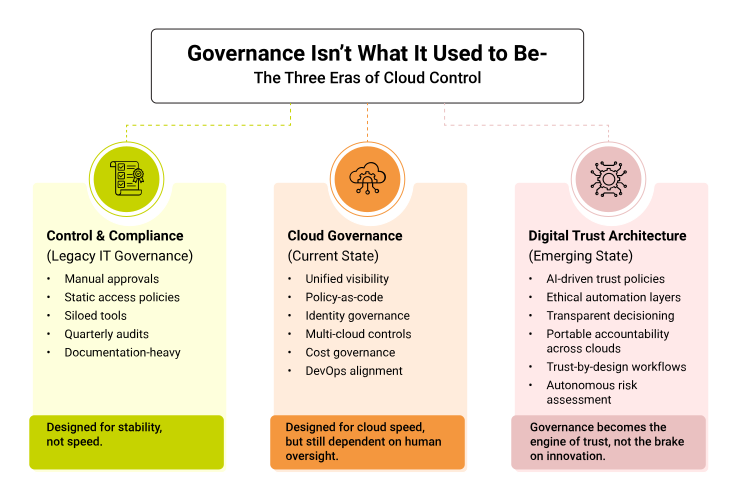
Traditional IT governance frameworks were created for stable, centralized, on-premise systems where infrastructure rarely changed and approvals moved through predictable processes. Those assumptions no longer hold true.
Today’s cloud environments evolve continuously. Resources are deployed on demand, services interact through APIs, and automation — especially AI-driven automation — modifies configurations in real time. Development teams operate in parallel, deploying workloads independently and integrating new capabilities quickly.
This level of speed and decentralization makes manual oversight impractical. And as enterprises adopt hybrid and multi-cloud architectures to support performance, resilience, and flexibility, the governance surface expands even further. Each cloud platform introduces its own policies, tools, and identity models, increasing the complexity of maintaining consistent governance.
Modern cloud governance must therefore shift from static documentation to continuous, automated, architecture-embedded controls. Without this shift, the environment evolves faster than governance can respond.
Five Cloud Governance Challenges Putting Enterprises at Risk
As enterprises scale their cloud footprint, governance often becomes the first area to show signs of stress. What starts as small inconsistencies can quickly turn into operational, financial, and security risks. Below are five critical cloud governance challenges that today’s organizations must address before they escalate.
1. Lack of Unified Visibility Across Multi-Cloud Environments
As enterprises expand across multiple clouds, visibility becomes fragmented. Each platform offers its own dashboards, metrics, and logs, making it difficult to build a consolidated view of configurations, dependencies, and risk exposure. Without unified observability, organizations develop governance blind spots—areas where misconfigurations, vulnerabilities, or policy violations go unnoticed.
2. Inconsistent Policy Enforcement and the Growth of Shadow IT
Different cloud providers enforce different defaults, tagging practices, and access controls. When multiple teams deploy workloads independently, configurations become inconsistent, and governance policies fail to apply uniformly. Meanwhile, shadow IT — unsanctioned cloud resources created outside formal processes — further weakens governance. Low-code platforms and AI-driven services amplify this risk, allowing users to spin up capabilities without IT involvement.
3. Cost Governance and Resource Sprawl
Cloud spending rises quickly when resources are created without ownership, tracking, or guardrails. Idle workloads, oversized instances, and duplicate environments accumulate silently. Without clear financial governance, enterprises face budget overruns and lack visibility into which teams or projects are driving costs. As cloud grows more decentralized, cost governance must integrate tightly with real-time operational metrics.
4. Identity and Access Governance Failures
Identity sprawl is one of the most dangerous cloud governance gaps. Enterprises manage thousands of human, service, and API identities across cloud platforms. Weak role definitions, excessive permissions, and poor lifecycle management undermine zero-trust security. As identities multiply, the attack surface expands, making governance essential to protect sensitive workloads.
5. Regulatory and Compliance Misalignment
Regulations like GDPR, HIPAA, DPDP, and industry-specific standards evolve continuously. Multi-cloud architectures make compliance even more complex, because data may move across regions or providers without centralized oversight. Manual audits and static documentation cannot keep up with continuous deployment. Compliance drift becomes a major legal and reputational risk.
Recommended Read: Critical Cloud Security Challenges Every Enterprise Must Solve
The Hidden Cost of Weak Cloud Governance
The consequences of poor cloud governance aren’t always immediate, but they accumulate quickly:
- Operational costs increase due to unused, duplicated, or misconfigured resources.
- Compliance gaps emerge, exposing the organization to audits, penalties, and legal scrutiny.
- Security vulnerabilities grow, often caused by misconfigured storage, excessive permissions, or overlooked identities.
- Reputational risk rises, especially when governance failures lead to data exposure or service disruptions.
Weak governance doesn’t break cloud environments — it slowly erodes them from within.
Building a Modern Cloud Governance Architecture
A strong cloud governance framework is not an add-on. It must be built into the architecture itself. Modern governance requires three foundational pillars:
1. Visibility
Enterprises need a unified, real-time view across clouds, workloads, and identities. Without comprehensive observability, governance cannot adapt to rapid changes.
2. Control
Policies must be enforced automatically through mechanisms such as policy-as-code, automated guardrails, and intelligent access management. Automation is the only way to govern environments that evolve in seconds.
3. Accountability
Cloud operations must be measurable. Compliance posture, cost allocation, security status, and policy adherence should all be tracked continuously to ensure alignment with business priorities.
Together, these pillars transform cloud governance from a reactive function into a proactive discipline.
Learn more about Sify’s cloud services here.
A Five-Step Roadmap for Governance Modernization
Enterprises looking to strengthen cloud governance should move through a structured modernization journey:
1. Establish a Governance Baseline by inventorying cloud assets, classifying data, mapping dependencies, and assigning ownership.
2. Implement Policy-as-Code to embed security and compliance requirements directly into deployment pipelines.
3. Centralize Visibility and Observability to unify telemetry and eliminate governance blind spots across cloud environments.
4. Automate Identity and Access Governance to enforce least privilege, manage identity lifecycle, and eliminate permission sprawl.
5. Integrate Financial and Compliance Governance, ensuring cost optimization and regulatory alignment share a unified control plane.
This approach gives enterprises clarity, consistency, and the ability to govern cloud environments at scale.
The Rise of Autonomous Cloud Governance
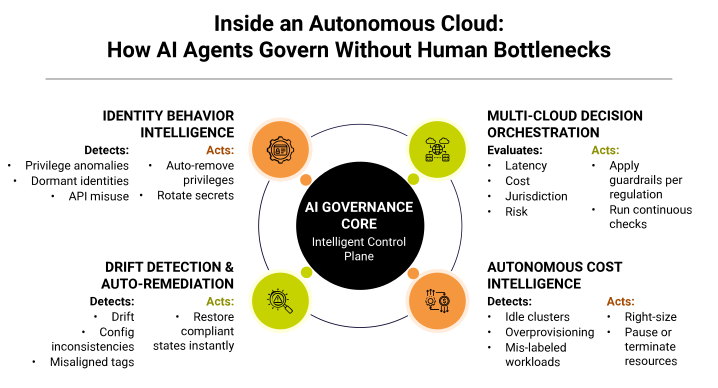
As cloud ecosystems grow more dynamic, AI-driven governance models are emerging as the new control plane. Autonomous cloud governance uses intelligent agents to continuously evaluate, correct, and optimize cloud environments.
These AI capabilities include self-healing infrastructure, automated compliance monitoring, predictive insights into drift or anomalies, identity intelligence that outpaces manual review, and policy frameworks that learn and evolve. This shift minimizes human error and enables governance that matches the speed of cloud innovation.
How Sify Technologies Strengthens Cloud Governance for Enterprises
Sify delivers a unified and modern approach to cloud governance through deep architectural expertise and advanced managed services. By integrating automation, observability, and AI-driven insights, Sify helps enterprises build cloud environments that are secure, compliant, and financially optimized.
CloudInfinit + AI Platform
Sify’s CloudInfinit platform provides unified visibility across hybrid and multi-cloud environments. With AI-powered policy enforcement, intelligent cost governance, and continuous monitoring, CloudInfinit acts as a central cockpit for cloud governance.
Managed Cloud Services
Sify’s managed services ensure ongoing enforcement of security policies, identity and access governance, compliance alignment, and automated guardrails. Predictive insights identify drift, anomalies, and cost inefficiencies before they create risk.
Together, these capabilities position Sify as a trusted partner for enterprises looking to modernize governance across complex cloud ecosystems.
Enterprises don’t need more rules — they need better alignment between cloud operations and business strategy. To know more about how you can champion that, speak to our experts.