


Unconscious bias shapes decisions in ways most people never recognize. At Merck, leaders needed a coaching toolkit that would help managers see their blind spots and develop more effective coaching relationships. The answer came through an immersive virtual reality solution that transformed how new coaches learn to lead.
About Merck
Merck operates as a global healthcare leader, providing innovative medicines and vaccines to address critical health challenges. The company employs thousands of professionals worldwide and maintains a strong commitment to developing its people through comprehensive leadership programs.
The Coaching Challenge
Merck adopted the O.F.T.E.N (Open, Focus, Transition, Engage and Next Steps) coaching model to standardize how managers develop their teams. New coaches received training through classroom role-playing exercises, supported by facilitator guides and coaching worksheets. Participants learned to assess performance readiness, select appropriate coaching styles, and structure meaningful conversations.
The classroom approach delivered knowledge, but it fell short on a critical dimension: helping coaches recognize how unconscious bias influences their decisions.
Several types of bias commonly derail coaching conversations. Performance evaluation bias leads managers to give less credit for successful outcomes to certain employees. Recency bias causes coaches to focus only on the past few weeks rather than the full evaluation period. The similar-to-me bias prompts higher ratings for employees who remind managers of themselves. The horns and halos effect creates assumptions about someone’s entire performance based on limited personality factors.
These biases operate beneath conscious awareness. Managers influenced by them may skew coaching conversations, lower employee morale, and ultimately harm productivity and revenue. Classroom lectures and role-plays alone couldn’t create the emotional awareness needed to counteract these deep-seated patterns.
Rajesh Nambiar, Vice President of Digital Learning at Sify, explains the gap: “Managers needed more than intellectual understanding. They needed to experience what it feels like to be on the receiving end of biased coaching. Only then could they recognize these patterns in their own behavior and make different choices.”
Learning and Business Objectives
Merck and Sify outlined three core objectives for the VR-based coaching solution:
- Enable coaches to accurately assess the performance readiness behavior of employees without bias influencing their judgment
- Help coaches select appropriate coaching styles based on actual employee readiness rather than stereotypes
- Apply the O.F.T.E.N coaching model effectively by recognizing and mitigating unconscious bias at each step
A Blended Approach: VR Meets Traditional Training
Sify had previously developed a VR solution for Merck that addressed unconscious bias in hiring. That implementation delivered strong results and provided valuable insights into how virtual reality could change behavior around sensitive topics.
Building on that success, Sify designed a VR coaching simulation that complemented the existing classroom training. The solution uses immersive technology to place new coaches inside coaching scenarios where they can experience bias from multiple perspectives.
The VR approach offers distinct advantages over traditional role-plays. It creates standardized scenarios that deliver consistent results. It allows coaches to practice challenging conversations in a safe environment where they can make mistakes without real-world consequences. It generates detailed metrics on how participants identify and respond to bias situations. Most importantly, it triggers empathy by letting coaches experience what their employees feel during biased interactions.
Creating Immersion Through Design
Sify used sophisticated techniques to connect participants physically and emotionally to the virtual environment.
The team replicated Merck’s actual office lobby in the VR space, creating positive association between the real and virtual worlds. When participants saw familiar surroundings, they unconsciously connected more deeply with the experience.
The solution also employed classical conditioning by mirroring physical body movements. Participants used hand gestures, head movements, and walking motions that matched what they would do in real coaching conversations. This physical engagement strengthened the connection between the training and actual workplace interactions.
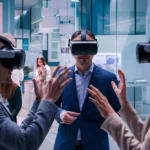
Participants accessed the experience through HTC Vive headsets with six degrees of freedom, providing sophisticated visual and auditory immersion. For wider accessibility, Sify also developed a smartphone-based version that works with VR cardboard devices, allowing coaches to complete the training on Merck-managed mobile phones.
The Three-Part Learning Journey
Assess Performance Readiness
In the first activity, participants play the role of a sales representative being coached by a fictional manager influenced by unconscious bias. They watch and experience a two-way conversation where the coach assesses the sales rep’s performance through a biased lens.
The scenario highlights specific bias behaviors through visual indicators and dialogue. Participants see the sales rep’s profile presented as video content, including visual and text elements that might trigger bias. By stepping into the employee’s shoes, coaches develop empathy for people subjected to biased treatment.
Select Coaching Style
After experiencing bias as an employee, participants shift to the observer role. They watch conversations between a fictional coach and sales representative across multiple competencies: Sales Acumen, Customer Segmentation, Targeting, and Account Management.
Two scenarios unfold — one driven by negative stereotypes (performance evaluation bias and recency bias), another by positive stereotypes (similar-to-me bias and horns and halos effect). Participants select the coaching style they believe fits each situation, then answer questions about their choices.
The system captures baseline data on each participant’s ability to recognize bias influence. Immediate feedback explains how unconscious bias shaped the coaching interaction and the observer’s own decisions.
Apply O.F.T.E.N Coaching Model
In the final activity, participants adopt the role of coach. They watch a scenario showing a sales representative interacting with a physician, then assess the rep’s performance readiness and select appropriate coaching styles.
Next, they use the O.F.T.E.N model to structure a coaching conversation. Questions appear at each step of the model, prompting participants to consider how bias might influence their approach. The system provides feedback on their responses, reinforcing strategies to mitigate bias throughout the coaching process.
Technology That Scales
Behind the VR experience, Sify built a web-based admin tool that stores user data, manages question banks, and generates xAPI learning analytics reports. The tool connects to Sify’s Learning Record Store, allowing Merck to track actions within the VR application and measure effectiveness across the coaching program.
The mobile version extends access beyond Merck’s training facility. Coaches can complete the simulation wherever they work, removing location as a barrier to participation.
Measuring Impact
Merck collected data through xAPI analytics and Level 1 evaluation surveys. The results confirmed several benefits:
Coaches applied learning in real-time situations, driving higher retention and concept mastery. The safe environment reduced apprehension about being judged, encouraging honest exploration of difficult topics. The platform created complex scenarios that would be impractical or uncomfortable to recreate in classroom settings.
The VR experience trained behavioral awareness, helping coaches recognize and adjust for unconscious bias during actual coaching conversations. Real-time data and analytics allowed Merck to track training effectiveness and identify areas where coaches needed additional support.
What Participants Say
A Global Diversity & Inclusion Specialist at Merck describes the experience: “VR-based coaching engagement made the experience more impactful. I would love to see these VR-based systems being used for other soft skills and diversity and inclusion trainings.”
A Learning Partner from US Commercial Learning at Merck adds: “The VR-based tool will help coaches to put themselves in other’s shoes to see what they experience with regards to bias or exclusion.”
An HR Business Partner focused on Global Diversity and Inclusion notes the practical advantage: “The VR coaching experience is really cool. I enjoyed the experience. I really like the scalability aspect of the VR coaching tool being made available on Android and iOS mobile phones compared to the HTC Vive version that allows easy accessibility of the tool for the users.”
Building Better Coaching Relationships
Rajesh Nambiar reflects on the broader implications: “Coaching fails when bias creates distance between managers and their teams. This solution helps coaches see beyond stereotypes and engage with each person’s actual capabilities and needs. That shift creates stronger performance, better retention, and more inclusive leadership across the organization.”
Merck now has a scalable tool that blends seamlessly with existing leadership training. New coaches gain intellectual understanding through classroom sessions, then develop emotional awareness and behavioral skills through immersive VR scenarios. The combination produces leaders who recognize their biases, adjust their approach, and create more effective coaching relationships.